AI TOOL PROFILE
synq Review: Data Quality and Observability Software

- Data and Analytics
- Data Quality
- Mid-market companies
- Enterprise companies
- Data engineering teams
- Data-forward organizations
Pricing
Pricing was not clearly available from the provided evidence. Buyers should confirm current pricing on the vendor website.
At a glance
- Best for
- Mid-market companies, Enterprise companies, Data engineering teams, Data-forward organizations
- Key use cases
- Proactive Issue Detection, Data Governance Implementation, Root-Cause Analysis, Cost Optimization
- Integrations
- dbt, Snowflake, Google BigQuery, Amazon Redshift, Databricks
- Official website
- Visit synq official website
How AI is used
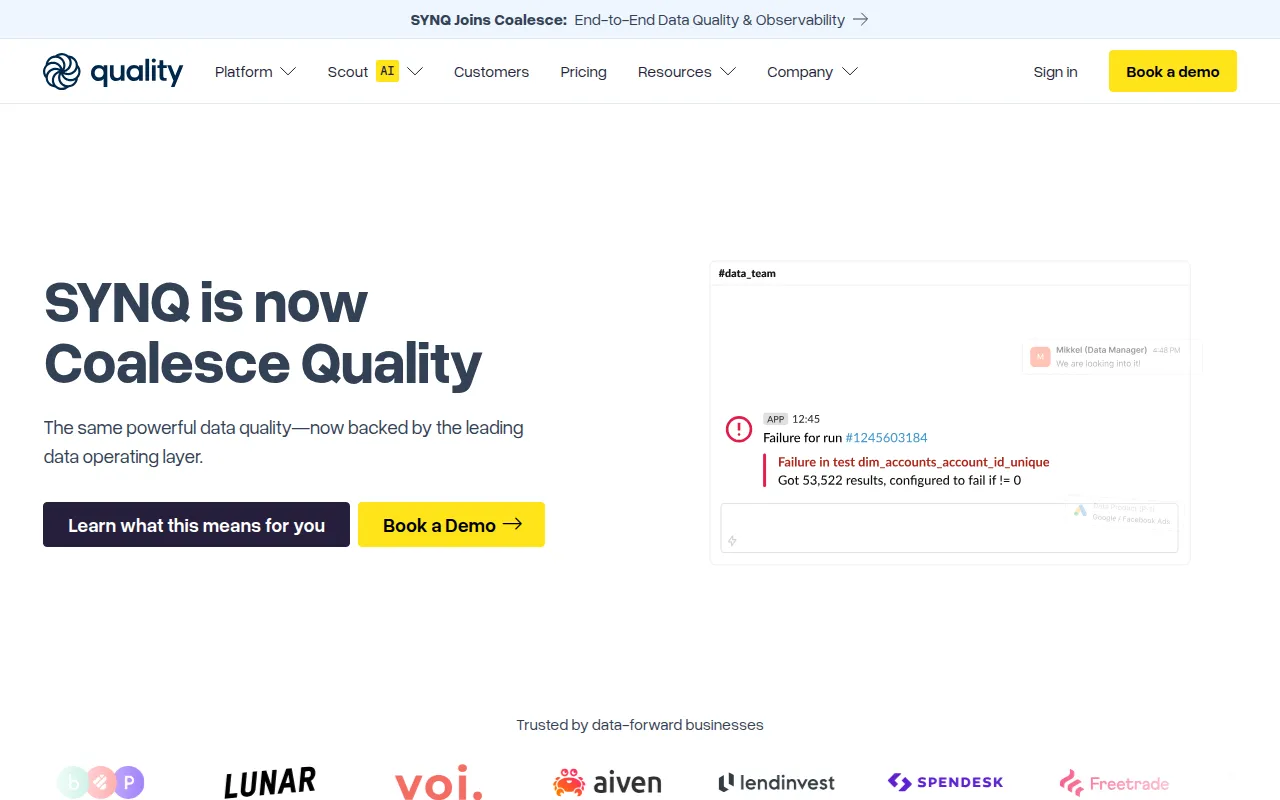
synq, now part of Coalesce, is a data quality and observability platform designed for data practitioners. It combines anomaly monitoring and testing to help teams detect data issues.
The software is designed for businesses that rely on data pipelines. It supports the identification of root causes through lineage and log-level details and includes an AI agent named Scout that can generate code suggestions to help fix identified issues.
Buyers should confirm if their current data stack includes supported warehouses and orchestrators, as the tool is designed to integrate with platforms like dbt and Snowflake.
Pricing is customized based on development needs, and prospective buyers will need to request a quote to understand the cost.
Key Features
Scout AI Agent
An autonomous agent that monitors data, triages alerts based on importance, and generates code suggestions for fixes.
Ownership Activation
Maps responsibility for critical data to stakeholders to help ensure issues are resolved by the correct owners.
Testing & Anomaly Monitoring
Combines dbt tests with anomaly detection to identify data irregularities.
Incident Management AI
Supports the triaging of data issues by identifying which business processes are impacted.
Data Products
Supports the definition of use cases as data products for visibility into critical data assets.
Platform Analytics
Provides an overview of data quality, usage, performance, and associated costs.
Use Cases
Proactive Issue Detection
Using anomaly monitors and dbt tests to identify data inaccuracies.
Data Governance Implementation
Establishing a framework for data ownership and criticality to manage how issues are prioritized.
Root-Cause Analysis
Reviewing code changes and log-level execution details to analyze why a data pipeline failed.
Cost Optimization
Analyzing data usage to identify models or tests that generate costs without downstream value.
Integrations
- dbt
- Snowflake
- Google BigQuery
- Amazon Redshift
- Databricks
FAQ
What is synq's Scout AI agent?
- Scout is an autonomous AI agent that monitors data, triages alerts, and generates code suggestions to help resolve data quality issues.
Who is synq designed for?
- The platform is designed for data practitioners and data teams within mid-market and enterprise companies.
How does synq handle pricing?
- synq provides customized licensing via a custom quote request based on development needs.
Source category: Data & Analytics
Source subcategory: Data Quality
More tools in Data & Analytics
Other published listings in the Data & Analytics category.


More tools in the Data Quality software type
Related listings that share the same software type for comparison and shortlisting.