AI TOOL PROFILE
Strobes: AI-Powered Exposure Management Platform

- Security
- Vulnerability Management
- Mid-market companies
- Enterprise security teams
- SecOps managers
- DevSecOps engineers
- CISOs
Pricing
Strobes offers a free basic plan. Paid annual tiers for up to 1,000 assets include ASM starting at $18,760, ASPM at $30,520, RBVM at $35,560, and CTEM at $53,760.
At a glance
- Best for
- Mid-market companies, Enterprise security teams, SecOps managers, DevSecOps engineers, CISOs
- Key use cases
- Consolidating Security Tool Noise, Continuous Threat Exposure Management (CTEM), Compliance and Acquisition Readiness, DevSecOps Workflow Integration
- Integrations
- Snyk, Burp Suite, Checkmarx, GitHub, AWS
- Official website
- Visit strobes ptaas official website
How AI is used
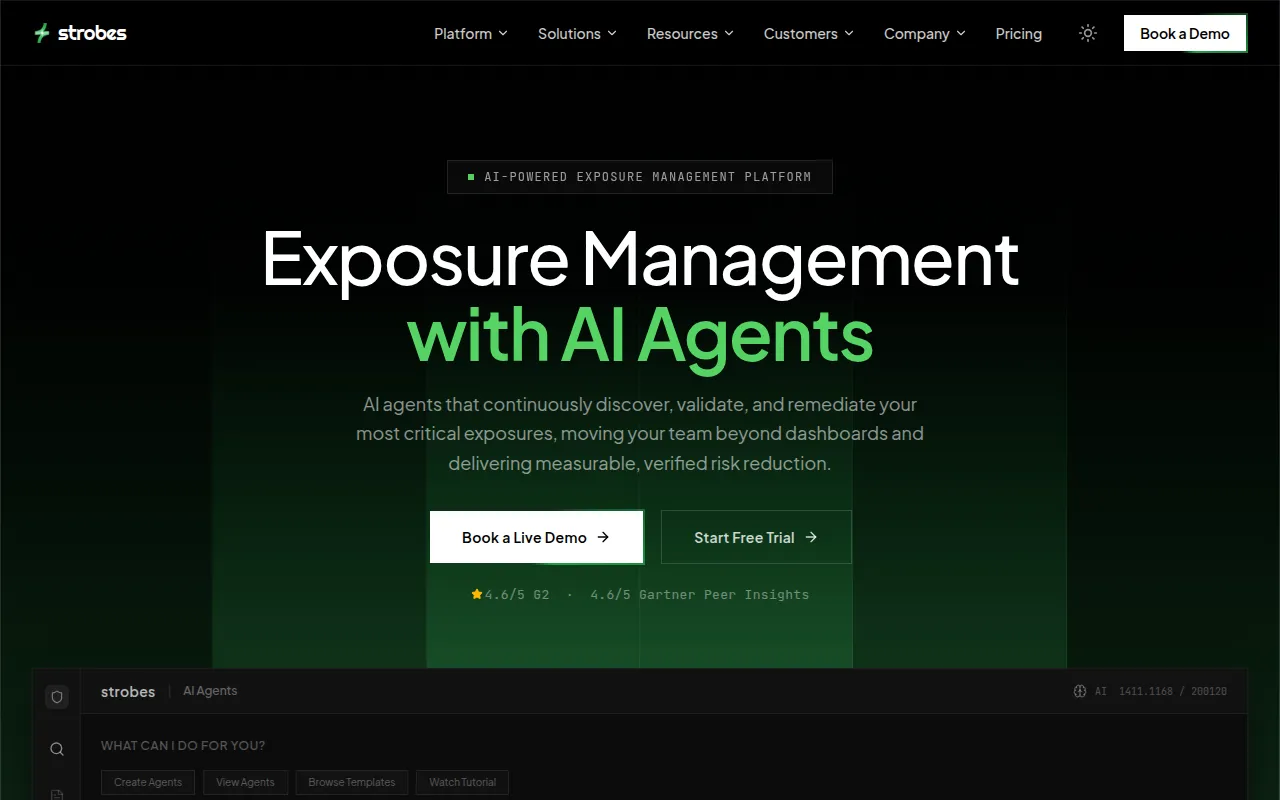
Strobes is an exposure management platform designed to sit between existing security scanners and engineering teams. It uses AI agents to aggregate findings from various sources, deduplicate noise, and validate whether a vulnerability is exploitable in a specific environment.
The tool supports functions including attack surface management, application security posture management (ASPM), and risk-based vulnerability management. By combining exploit intelligence with business context, the platform helps teams prioritize fixes beyond relying solely on CVSS scores. It also offers both autonomous AI pentesting and expert-led penetration testing as a service (PTaaS).
Buyers should confirm which pricing tier fits their asset count and determine if they require the full CTEM framework or a specific module like ASM or RBVM.
Key Features
AI Agents
Agents designed to triage, deduplicate, and recommend fixes for security exposures.
Attack Surface Management (ASM)
Supports continuous discovery and monitoring of external assets and shadow IT detection.
Application Security Posture Management (ASPM)
Aggregates findings from SAST, DAST, SCA, and container scanners into a single view.
Risk-Based Vulnerability Management (RBVM)
Prioritizes vulnerabilities using exploit intelligence and business context.
Adversarial Exposure Validation
Provides AI-driven autonomous pentesting and expert-led PTaaS to validate exploitability.
Integration Pipeline
Connects with over 100 security tools and supports Slack and Teams alerts.
Use Cases
Consolidating Security Tool Noise
Aggregating signals from multiple scanners to reduce duplicate findings.
Continuous Threat Exposure Management (CTEM)
Implementing a loop of scoping, discovery, prioritization, validation, and remediation.
Compliance and Acquisition Readiness
Using PTaaS to conduct application and network pentesting for audit requirements or due diligence.
DevSecOps Workflow Integration
Routing validated vulnerabilities to code owners via Jira and GitHub.
Integrations
- Snyk
- Burp Suite
- Checkmarx
- GitHub
- AWS
- SonarQube
- Jira
- Slack
- PagerDuty
- Splunk
- Azure DevOps
FAQ
Who is Strobes designed for?
- Strobes is designed for security, SecOps, and DevSecOps teams within mid-market and enterprise-level companies.
How does Strobes handle pricing?
- It uses a freemium model with a free basic plan and paid annual tiers based on asset ranges, starting at $18,760/year for the ASM module.
Does Strobes replace existing vulnerability scanners?
- No, it is designed as an operational layer that sits between existing scanners and engineering teams to prioritize and validate findings.
Source category: Security
Source subcategory: Vulnerability Management
More tools in Security
Other published listings in the Security category.


More tools in the Vulnerability Management software type
Related listings that share the same software type for comparison and shortlisting.