AI TOOL PROFILE
FireCompass Review: Automated Penetration Testing & ASM

- Security
- Vulnerability Management
- Enterprise security teams
- Mid-market companies
- Security Operations (SecOps) managers
- Organizations with dynamic attack surfaces
Pricing
FireCompass uses a credit-based subscription. The Explorer tier provides $3,000+ in annual credits, while the Enterprise Pilot provides $5,000 to $10,000 in one-time credits for a 30-day evaluation.
At a glance
- Best for
- Enterprise security teams, Mid-market companies, Security Operations (SecOps) managers, Organizations with dynamic attack surfaces
- Key use cases
- Continuous Attack Surface Mapping, Simulating Complex Attack Paths, Automated Web Application Testing, Vendor Security Assessments
- Official website
- Visit firecompass official website
How AI is used
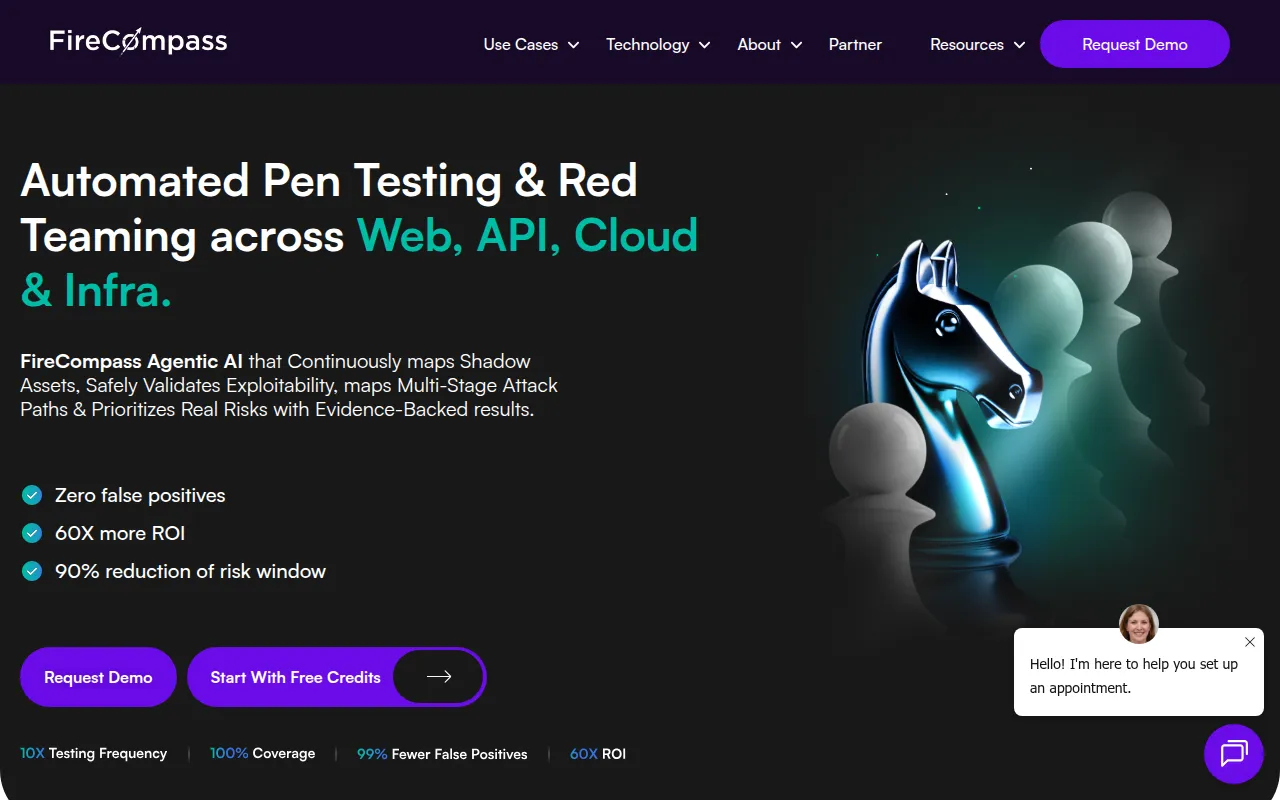
FireCompass is a security platform designed to simulate how attackers target an organization. It combines reconnaissance and vulnerability testing to help security teams map their digital footprint and validate whether identified vulnerabilities can be exploited. The tool supports the management of cloud infrastructure, APIs, and web applications, using an AI engine to orchestrate attack simulations and identify shadow IT assets.
Key Features
Automated Penetration Testing
Conducts security tests across web, API, cloud, and infrastructure to identify and validate exploitable vulnerabilities.
Continuous Red Teaming (CART)
Simulates multi-stage attacker paths and kill-chains based on the MITRE ATT&CK framework.
Attack Surface Management (ASM)
Maps the external digital footprint to help discover shadow IT and exposed assets such as databases and open ports.
Agentic AI Orchestration
Uses AI to coordinate asset discovery, generate attack plans, and execute simulations.
Attack Tree Engine (PARC)
A patented system that chains multiple weak signals to identify and prioritize exploitable attack paths.
Third-Party Risk Management
Supports monitoring the security posture of vendors and supply chain partners by identifying leaks and network vulnerabilities.
Use Cases
Continuous Attack Surface Mapping
Identifying unknown or forgotten assets and shadow IT across DNS, IPs, and SSL certificates.
Simulating Complex Attack Paths
Using red teaming playbooks to test for lateral movement and privilege escalation.
Automated Web Application Testing
Testing public-facing and authenticated application flows for business-logic flaws.
Vendor Security Assessments
Passively collecting data and scanning vendor networks to assess the security posture of third-party providers.
FAQ
How does FireCompass differ from a standard vulnerability scanner?
- While scanners identify CVEs based on static metrics, FireCompass attempts to exploit vulnerabilities to provide evidence of exploitability and map actual attack paths.
What is the difference between the Explorer and Enterprise Pilot plans?
- Explorer is a self-serve tier with annual credits for web app and surface recon, while Enterprise Pilot is a 30-day guided evaluation with higher one-time credits and expanded features like Infra PT and PTaaS.
Is software installation required to use FireCompass?
- No agent installation is required, as the platform operates externally against the defined scope.
Source category: Security
Source subcategory: Vulnerability Management
More tools in Security
Other published listings in the Security category.


More tools in the Vulnerability Management software type
Related listings that share the same software type for comparison and shortlisting.