AI TOOL PROFILE
Giskard AI Security Testing and LLM Evaluation

- Security
- Vulnerability Management
- Software companies
- Enterprise AI teams
- Product managers
- Domain experts overseeing AI safety
Pricing
Giskard offers an open-source library for solo LLM experiments for free. Pricing for the enterprise Giskard Hub was not clearly available from the provided evidence. Buyers should confirm current pricing on the vendor website.
At a glance
- Best for
- Software companies, Enterprise AI teams, Product managers, Domain experts overseeing AI safety
- Key use cases
- Pre-deployment Security Validation, Continuous Production Monitoring, RAG Agent Evaluation, Regulatory Compliance Testing
- Official website
- Visit Giskard official website
How AI is used
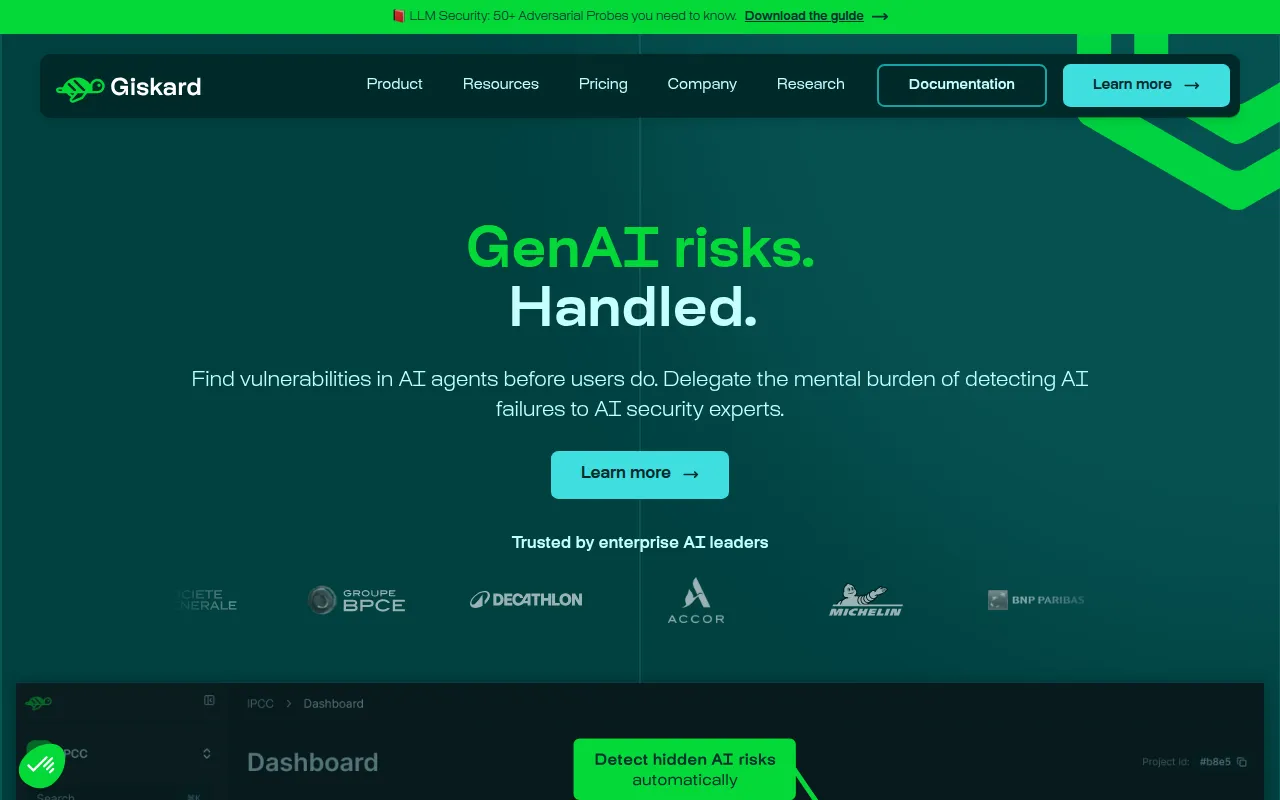
Giskard is an automated security testing platform designed for conversational AI agents that operate in text-to-text mode. It uses an AI red teamer to generate multi-turn attacks that adapt to a bot's responses, rather than relying on static tests. The tool operates as a black-box system, requiring only API endpoint access to evaluate the agent.
The software is intended for organizations that deploy LLM agents and need to monitor for hallucinations, prompt injections, and the disclosure of personal information. It supports the use of internal business context, such as knowledge bases and PDFs, to create targeted test scenarios specific to a company's operational scope.
Buyers should note that the platform is divided between an open-source library for solo experiments and a Hub for production deployments. Those requiring on-premise installation for sensitive workloads, such as public sector or defense applications, may do so through Giskard's engineering team.
Key Features
Dynamic Multi-Turn Attacks
Uses an AI red teamer to generate adaptable attacks based on the agent's responses.
Context-Aware Detection
Uses internal business documents and knowledge bases to create use-case specific tests.
Black-Box API Testing
Evaluates LLM agents via API endpoints without requiring access to internal foundation models or vector databases.
Vulnerability Scanning
Detects hallucinations, prompt injections, stereotypes, discrimination, and harmful content.
CI/CD Integration
Supports the automation of security tests within the development pipeline.
Compliance Support
Designed to meet SOC2, HIPAA, and GDPR requirements for enterprise deployments.
Use Cases
Pre-deployment Security Validation
Generating quantitative KPIs to help determine if an AI agent is production-ready.
Continuous Production Monitoring
Detecting vulnerabilities that may emerge after an AI application is live.
RAG Agent Evaluation
Generating test cases to evaluate answer correctness and detect weaknesses in RAG components.
Regulatory Compliance Testing
Aligning AI security testing with frameworks such as OWASP for regulated sectors like banking and insurance.
FAQ
What types of AI agents does Giskard support?
- The Giskard Hub specifically supports conversational AI agents that operate in text-to-text mode and are accessible via an API endpoint.
Can Giskard be installed on-premise?
- Yes, Giskard can be installed in on-premise environments, specifically for mission-critical workloads in defense, the public sector, or other sensitive applications.
What is the difference between Giskard Open-Source and Giskard Hub?
- The open-source library is for solo experiments and offers basic scans and community support, while the Hub is an enterprise platform with over 50 automated probes, CI/CD integration, SSO, and regulatory compliance support.
When should Giskard be used in the development lifecycle?
- It is designed for use both before deployment to help ensure an agent is production-ready and after deployment to continuously detect new vulnerabilities.
Source category: Security
Source subcategory: Vulnerability Management
More tools in Security
Other published listings in the Security category.


More tools in the Vulnerability Management software type
Related listings that share the same software type for comparison and shortlisting.