AI TOOL PROFILE
Fluid Topics: Product Knowledge Platform

- Operations
- Knowledge Management
- Technical writers
- Customer support operations
- Field service teams
- Product engineering leads
- CIOs and IT leaders
Pricing
Pricing was not clearly available from the provided evidence. Buyers should confirm current pricing on the vendor website.
At a glance
- Best for
- Technical writers, Customer support operations, Field service teams, Product engineering leads, CIOs and IT leaders
- Key use cases
- Self-Service Documentation Portals, AI Chatbot Implementation, Helpdesk Integration, In-Product Help
- Integrations
- Adobe Experience Manager, Zendesk, Zoho Desk, Salesforce, Confluence
- Official website
- Visit fluid topics official website
How AI is used
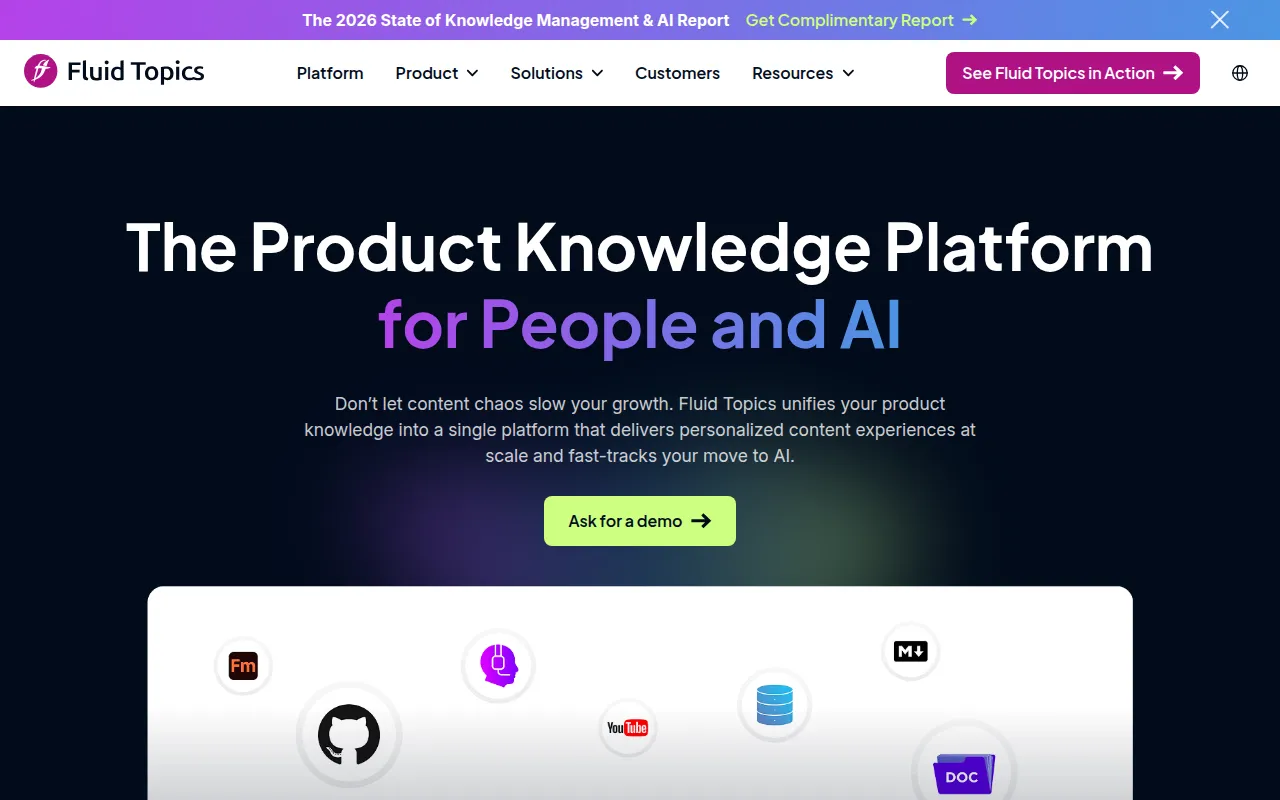
Fluid Topics is a Product Knowledge Platform designed to centralize technical information from various sources and formats. It serves as a knowledge layer that connects a company's product content to users and AI applications via a unified hub.
The tool is designed for technical writers, CIOs, and support teams who manage large volumes of product data. It helps by restructuring diverse formats to be AI-ready, which supports the deployment of grounded AI assistants and self-service portals.
Beyond content delivery, the platform includes tools for analyzing how users interact with documentation, which may help teams identify knowledge gaps. Buyers should confirm if the platform's security and permission settings align with their specific compliance requirements.
Key Features
AI-Powered Search
Combines keyword and semantic search to provide contextual results based on user roles and preferences.
Portal Designer
A WYSIWYG editor used to build and customize branded documentation portals for different audiences.
Generative AI & RAG
Provides retrieval-augmented generation (RAG) services, including embeddings and prompt management, to support grounded AI chatbots.
Content Analytics
Tracks search queries and user journeys to help identify content bottlenecks and knowledge gaps.
Unified Knowledge Hub
Supports syncing and structuring content from multiple sources, including DITA support.
Use Cases
Self-Service Documentation Portals
Creating centralized hubs where clients and vendors can access technical product information.
AI Chatbot Implementation
Deploying chatbots grounded in proprietary product knowledge to provide sourced, conversational answers.
Helpdesk Integration
Bringing product guides and resources into helpdesk tools to support agents and help with case deflection.
In-Product Help
Delivering context-sensitive guidance and assistance directly within a software interface.
Integrations
- Adobe Experience Manager
- Zendesk
- Zoho Desk
- Salesforce
- Confluence
- Sharepoint
- Jira
- OpenAI
- GitHub
- Word
FAQ
What is a documentation portal in Fluid Topics?
- It is a centralized self-service point of access where customers and partners can find tools, resources, and technical information related to a product.
How does the AI chatbot ensure accuracy?
- The chatbot is grounded in the company's proprietary product knowledge using RAG (Retrieval-Augmented Generation), and provides transparent sourcing with direct links to the original documentation.
Can Fluid Topics handle different languages?
- Yes, it supports multilingual search and delivery, allowing users to find accurate answers even if the content is not in their native language.
Source category: Operations
Source subcategory: Knowledge Management
More tools in Operations
Other published listings in the Operations category.


More tools in the Knowledge Management software type
Related listings that share the same software type for comparison and shortlisting.