AI TOOL PROFILE
ModMed: Cloud-Based EHR & Practice Management for Specialty Practices

- Healthcare
- Practice Management
- Specialty medical practices
- Physicians using tablet-based documentation
- Practices seeking integrated EHR and billing systems
- Medical providers using AI-assisted charting
Pricing
Pricing was not clearly available from the provided evidence. Buyers should confirm current pricing on the vendor website.
At a glance
- Best for
- Specialty medical practices, Physicians using tablet-based documentation, Practices seeking integrated EHR and billing systems, Medical providers using AI-assisted charting
- Key use cases
- Clinical Documentation, Administrative Office Management, Billing and Claims Processing, Lab and Imaging Coordination
- Integrations
- Surescripts ePrescribing, Nuance Dragon Medical Speechkit, Quest Diagnostics, Labcorp, FHIR API
How AI is used
ModMed is a cloud-based healthcare platform that combines Electronic Health Records (EHR) with practice management and revenue cycle tools. It is designed for specialists in fields such as otolaryngology, dermatology, and orthopedics, focusing on specialty-specific workflows.
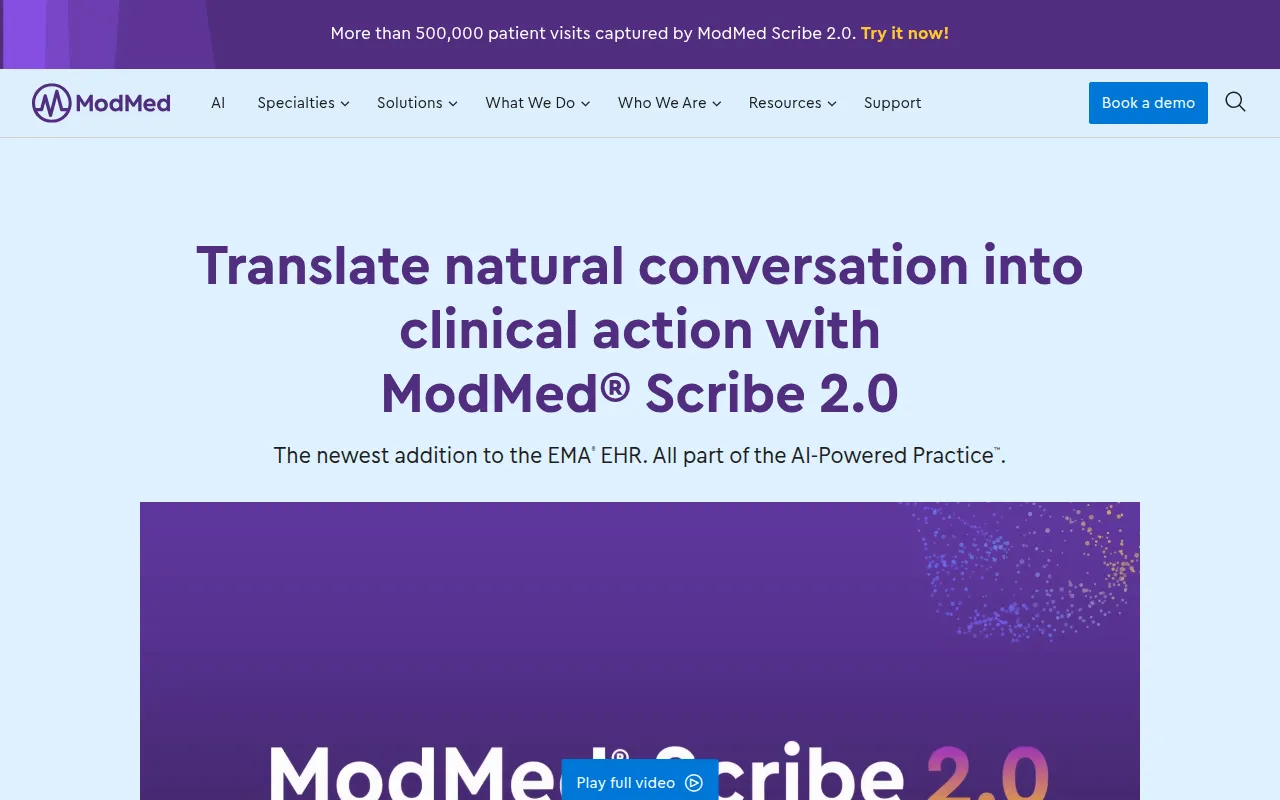
The software supports clinical tasks through the Electronic Medical Assistant (EMA) platform and provides AI-powered ambient listening via ModMed Scribe, which helps convert provider-patient conversations into suggested notes and billing codes. Administratively, the platform handles appointment scheduling, insurance eligibility, and claims processing.
Buyers should confirm that while the system is designed to reduce manual data entry, the full range of administrative and financial tools requires the integrated practice management module. The software is designed for browser-based access and tablet use, which may influence staff training and exam room configuration.
Key Features
ModMed Scribe
An AI-powered ambient listening tool that suggests clinical notes, ICD and CPT codes, and actions based on patient conversations.
Specialty-Specific EHR
The EMA platform uses structured data and a keyboardless interface tailored to the needs of 11 different medical specialties.
Integrated Practice Management
A hub for administrative tasks including scheduling, automated eligibility verification, and patient waitlist management.
Revenue Cycle Management (RCM)
Tools for managing billing workflows, claim scrubbing, and financial dashboards to track reimbursements.
Lab Connectivity
Interfaces with pathology labs and clinical labs like Quest and Labcorp to submit orders and receive results electronically.
Patient Engagement Tools
Includes a patient portal for refills and messaging, as well as self-scheduling and digital check-in kiosks.
Use Cases
Clinical Documentation
Using AI ambient listening to capture patient visit details and generate suggested clinical notes and codes.
Administrative Office Management
Managing patient scheduling, insurance eligibility checks, and front-office check-in/checkout processes.
Billing and Claims Processing
Generating encounter forms from clinical notes and managing the submission and tracking of insurance claims.
Lab and Imaging Coordination
Electronically sending orders to pathology or clinical labs and receiving results directly into the patient chart.
Integrations
- Surescripts ePrescribing
- Nuance Dragon Medical Speechkit
- Quest Diagnostics
- Labcorp
- FHIR API
- HL7 PM interfaces
FAQ
What medical specialties does ModMed support?
- ModMed supports 11 specialties, including allergy, dermatology, ENT, gastroenterology, OBGYN, ophthalmology, orthopedics, pain management, plastic surgery, podiatry, and urology.
How does the AI Scribe work in ModMed?
- The AI Scribe uses ambient listening to capture provider-patient conversations and suggest visit notes, ICD-10 codes, and clinical actions for the provider to review and approve.
Is a practice management system required to use the EHR?
- No, the EHR can be used for medical record-keeping and documentation without it, but a practice management system is required for advanced scheduling, intake, and billing support.
Source category: Healthcare
Source subcategory: Practice Management
More tools in Healthcare
Other published listings in the Healthcare category.


More tools in the Practice Management software type
Related listings that share the same software type for comparison and shortlisting.