AI TOOL PROFILE
CTERA: Hybrid Cloud File Storage
- Data and Analytics
- Cloud Infrastructure
- Mid-market companies
- Enterprise companies
- Organizations with multiple remote office locations
- Companies managing large volumes of unstructured data
Pricing
Pricing was not clearly available from the provided evidence. Buyers should confirm current pricing on the vendor website.
At a glance
- Best for
- Mid-market companies, Enterprise companies, Organizations with multiple remote office locations, Companies managing large volumes of unstructured data
- Key use cases
- NAS Modernization, Remote Workforce Enablement, Ransomware Defense, AI Readiness, Regulatory Compliance
- Integrations
- Amazon Web Services (AWS), Microsoft Azure, Google Cloud Platform (GCP), Active Directory, Entra ID
- Official website
- Visit ctera official website
How AI is used
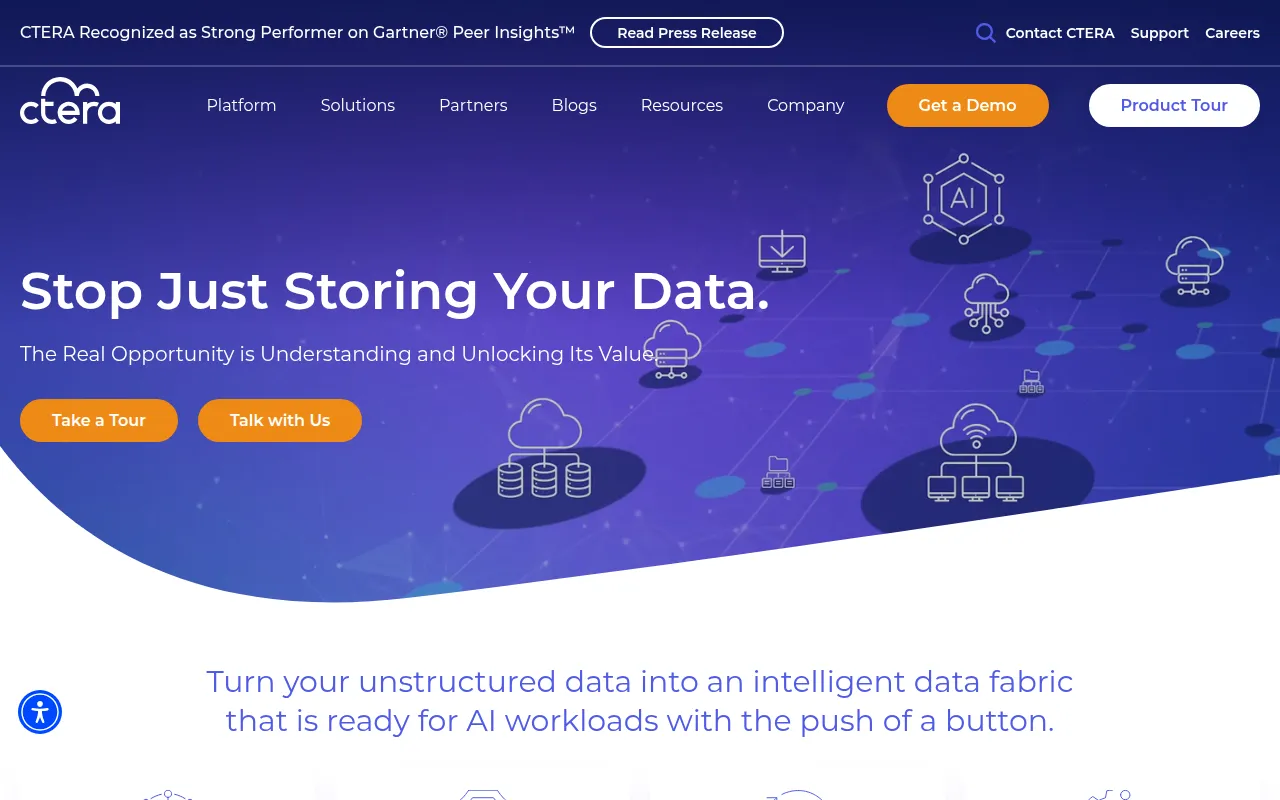
CTERA provides a software-defined hybrid cloud file storage platform designed to unify disparate data silos into a single global file system. It is built for organizations that coordinate data between on-premises hardware, edge locations, and public cloud environments.
The platform supports various access methods, including virtual appliances for remote offices and desktop or mobile applications for end-users. It uses a Zero-Trust architecture and immutable storage to protect against data loss.
For organizations using AI, CTERA is designed to make unstructured data available for Large Language Models (LLMs) via protocols like the Model Context Protocol. This supports analysis and retrieval without the need to create multiple copies of the data.
Buyers should confirm their technical capacity, as the system is designed for enterprise-level deployment.
Key Features
Global File System
Unifies public cloud and on-premises infrastructure into a single logical namespace.
Ransom Protect
Uses AI-driven behavioral analytics to detect ransomware attacks and supports recovery via immutable snapshots.
Edge Filers
Virtual appliances that provide caching and protocol gateway services (NFS, SMB) for remote office locations.
Zero-Trust Security
Implements end-to-end AES-256 encryption and continuous verification for data access.
Immutable WORM Compliance
Enforces Write-Once-Read-Many policies to create tamper-proof records for mandates such as HIPAA and FINRA.
Global File Locking
Provides centralized locking for shared files to help distributed teams avoid version conflicts.
Enterprise AI Integration
Supports Retrieval-Augmented Generation (RAG) by connecting LLMs like Claude 3 and OpenAI-GPT to proprietary files.
Use Cases
NAS Modernization
Replacing aging on-premises NAS hardware with a unified cloud-integrated storage fabric.
Remote Workforce Enablement
Providing distributed employees and job sites access to corporate files via CTERA Drive and Edge Filers.
Ransomware Defense
Using AI-based detection and immutable backups to protect enterprise data from encryption attacks.
AI Readiness
Preparing unstructured data for use in AI workloads and analytics engines.
Regulatory Compliance
Managing data residency and sovereignty requirements using policy-based data placement.
Integrations
- Amazon Web Services (AWS)
- Microsoft Azure
- Google Cloud Platform (GCP)
- Active Directory
- Entra ID
- LDAP
- SAML 2.0
- Okta
FAQ
What is CTERA used for?
- CTERA is used to unify file and object storage across edge, cloud, and data centers, helping enterprises replace legacy NAS with a centrally managed global file system.
How does CTERA protect against ransomware?
- The platform uses Ransom Protect, which employs AI-driven behavioral analytics to detect attacks and provides immutable snapshots for data recovery.
Who is the ideal buyer for CTERA?
- It is designed for mid-market and enterprise companies, particularly those in industries like AEC, healthcare, and manufacturing with distributed teams.
Does CTERA support AI integration?
- Yes, it supports the connection of Large Language Models (LLMs) such as Claude 3 and OpenAI-GPT to proprietary enterprise data for analysis and Retrieval-Augmented Generation (RAG).
Source category: Data & Analytics
Source subcategory: Cloud Infrastructure
More tools in Data & Analytics
Other published listings in the Data & Analytics category.


More tools in the Cloud Infrastructure software type
Related listings that share the same software type for comparison and shortlisting.


