AI TOOL PROFILE
Andromeda: GPU Compute Marketplace

- Productivity
- Cloud Infrastructure
- Software companies
- AI development teams
- GPU infrastructure providers
Pricing
Pricing was not clearly available from the provided evidence. Buyers should confirm current pricing on the vendor website.
At a glance
- Best for
- Software companies, AI development teams, GPU infrastructure providers
- Key use cases
- Sourcing AI Compute, Compute Cost Benchmarking, GPU Capacity Monetization
- Official website
- Visit andromeda official website
How AI is used
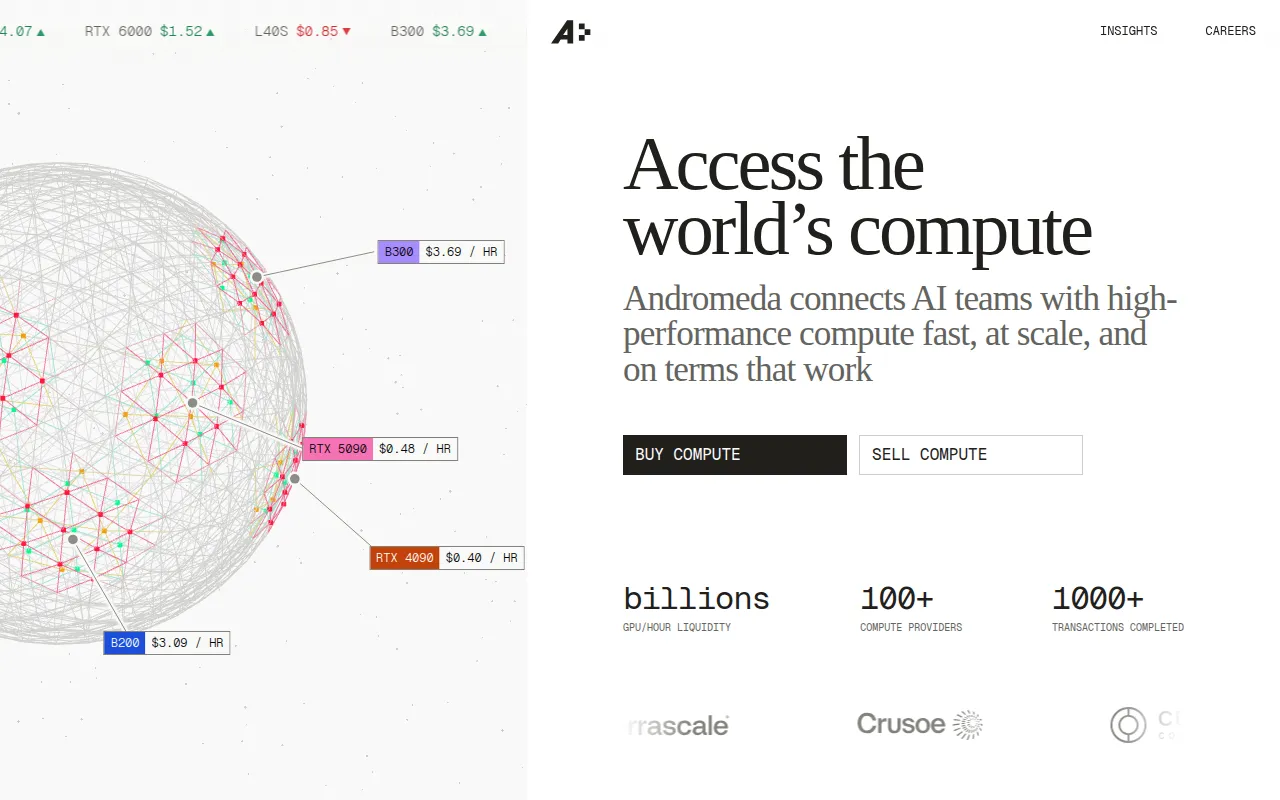
Andromeda acts as a marketplace for high-performance compute, connecting AI teams with a network of over 100 providers worldwide. The platform is designed to help buyers find GPU capacity by defining workload requirements, such as GPU type, quantity, and region.
For AI teams, the platform supports a workflow of sourcing, benchmarking, and deploying standardized configurations. This approach is intended to simplify procurement by providing a single invoice and a single support channel for the deployed resources.
Infrastructure providers can use the platform to onboard GPU capacity, undergo performance validation through a certification engine, and connect with qualified demand.
Buyers should confirm if the available GPU types and regional options in the marketplace align with their specific technical requirements and latency needs.
Key Features
GPU Marketplace
Connects AI teams with compute resources from over 100 global providers.
Andromeda Pricing Index
Tracks GPU prices across various types, regions, and contract terms to help buyers benchmark spend.
Workload Definition
Supports specifying GPU type, quantity, region, and timeline to source matching compute.
Standardized Configurations
Offers standardized SLAs and contracts to assist the selection and deployment process.
Unified Billing
Supports the use of a single invoice for compute resources sourced through the platform.
Infrastructure Certification
Validates provider performance against enterprise-grade benchmarks.
Use Cases
Sourcing AI Compute
Finding and deploying high-performance GPU clusters based on workload and regional requirements.
Compute Cost Benchmarking
Using the Pricing Index to track GPU costs across different regions and contract terms.
GPU Capacity Monetization
Allowing infrastructure providers to list GPU capacity and receive qualified demand.
FAQ
What does Andromeda do?
- Andromeda is a marketplace that connects AI teams with high-performance GPU compute resources from a network of over 100 providers globally.
Who is Andromeda designed for?
- It is designed for software companies and AI teams who need to source compute, as well as infrastructure providers who want to sell GPU capacity.
How does the Andromeda Pricing Index help buyers?
- The index tracks GPU prices across different types, regions, and contract terms, which helps buyers benchmark their spend.
Source category: Productivity
Source subcategory: Cloud Infrastructure
More tools in Productivity
Other published listings in the Productivity category.


More tools in the Cloud Infrastructure software type
Related listings that share the same software type for comparison and shortlisting.


