AI TOOL PROFILE
Teavaro: First-Party Identity Activation Software

- Marketing
- Marketing Automation
- Mid-market companies
- Enterprise organizations
- Businesses with 100,000+ monthly website visitors
- Marketing and data leaders
- Digital brands with complex multi-channel stacks
Pricing
Pricing was not clearly available from the provided evidence. Buyers should confirm current pricing on the vendor website.
At a glance
- Best for
- Mid-market companies, Enterprise organizations, Businesses with 100,000+ monthly website visitors, Marketing and data leaders, Digital brands with complex multi-channel stacks
- Key use cases
- Real-Time Customer Recognition, Onsite Personalization, Paid Media Optimization, Cross-Channel Data Activation, Person-Level Consent Management
- Integrations
- Open API, CRM systems, Analytics platforms, Paid media platforms, Data warehouses
- Official website
- Visit teavaro official website
How AI is used
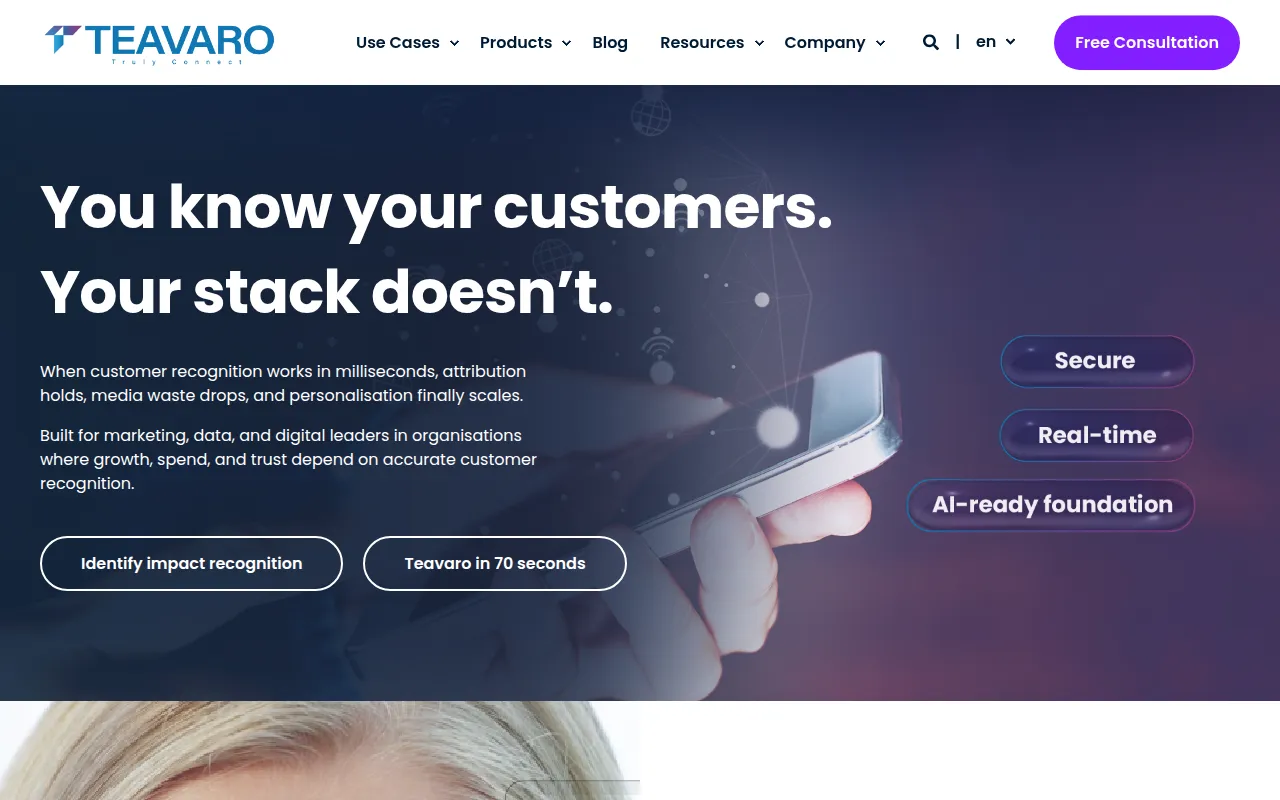
Teavaro is an identity activation layer designed to help businesses recognize customers across different systems and devices in real time. Instead of acting as a central database, it resolves fragmented signals into a deterministic identity graph that the business owns and controls.
The platform is designed for marketing and data leaders in mid-to-large organizations, particularly those with 100,000+ monthly visitors where customer recognition impacts media spend and personalization. It operates server-side to support privacy by design and is GDPR compliant.
It connects with existing MarTech and AdTech tools, allowing teams to identify customers and activate data without a full rip-and-replace project. This includes capabilities for managing person-level consent and distributing profiles via open APIs.
Buyers should confirm if their current traffic levels and first-party data signals meet the platform's requirements, as it may be less suitable for businesses with very low traffic or minimal digital signals.
Key Features
Marketing Identity Hub
Resolves customer identities in milliseconds using a Unified Marketing ID (UMID) to recognize people across devices.
Data Activation Hub
Connects unified customer identities to marketing and media systems in real time to support personalization and audience updates.
Consent Boost
A person-centric consent management layer that links marketing permissions to a customer identity rather than a browser cookie.
Connection Library
Provides open APIs and ready-to-use connectors to integrate with existing analytics, CRM, and media platforms.
Server-Side Operation
Processes identity and data flows on the server side to support privacy by design and GDPR compliance.
Use Cases
Real-Time Customer Recognition
Identifying anonymous visitors as known customers in real time to support analytics and attribution.
Onsite Personalization
Using resolved identities to support personalized web or app experiences during a live session.
Paid Media Optimization
Using first-party identity to suppress known customers from acquisition campaigns, which may reduce wasted media spend.
Cross-Channel Data Activation
Activating first-party data across email, paid media, and automation tools without requiring a central data warehouse.
Person-Level Consent Management
Maintaining consistent consent preferences across multiple devices and domains for a single user.
Integrations
- Open API
- CRM systems
- Analytics platforms
- Paid media platforms
- Data warehouses
FAQ
Does Teavaro replace my existing CDP or CRM?
- No, it is designed as an activation layer that plugs into your existing MarTech and AdTech stack via APIs and connectors without requiring a rip-and-replace project.
Who is the ideal buyer for Teavaro?
- It is best suited for mid-sized and large organizations, typically those with over 100,000 monthly website visitors where identity accuracy impacts growth and spend.
How is Consent Boost different from a standard CMP?
- Unlike traditional CMPs that are device-centric, Consent Boost links consent to the actual person, allowing preferences to persist across different devices and channels.
How long does implementation take?
- The provider states that implementation typically takes 2-4 weeks, with an initial use case launch often occurring within 30 days.
Source category: Marketing
Source subcategory: Marketing Automation
More tools in Marketing
Other published listings in the Marketing category.


More tools in the Marketing Automation software type
Related listings that share the same software type for comparison and shortlisting.


