AI TOOL PROFILE
Qlik Analytics Platform: Data Integration and Business Intelligence

- Data and Analytics
- Business Intelligence
- Enterprise companies
- Mid-market companies
- Small businesses with complex data needs
- IT and operations managers
Pricing
Pricing is structured separately for Data Integration and Quality, Analytics, and AI/ML. A free trial is available.
At a glance
- Best for
- Enterprise companies, Mid-market companies, Small businesses with complex data needs, IT and operations managers
- Key use cases
- Multi-Source Data Integration, Predictive Trend Analysis, Unstructured Data Querying, Data Pipeline Automation
- Integrations
- AWS, Google, Microsoft, Snowflake, SAP
- Official website
- Visit qlik analytics platform official website
How AI is used
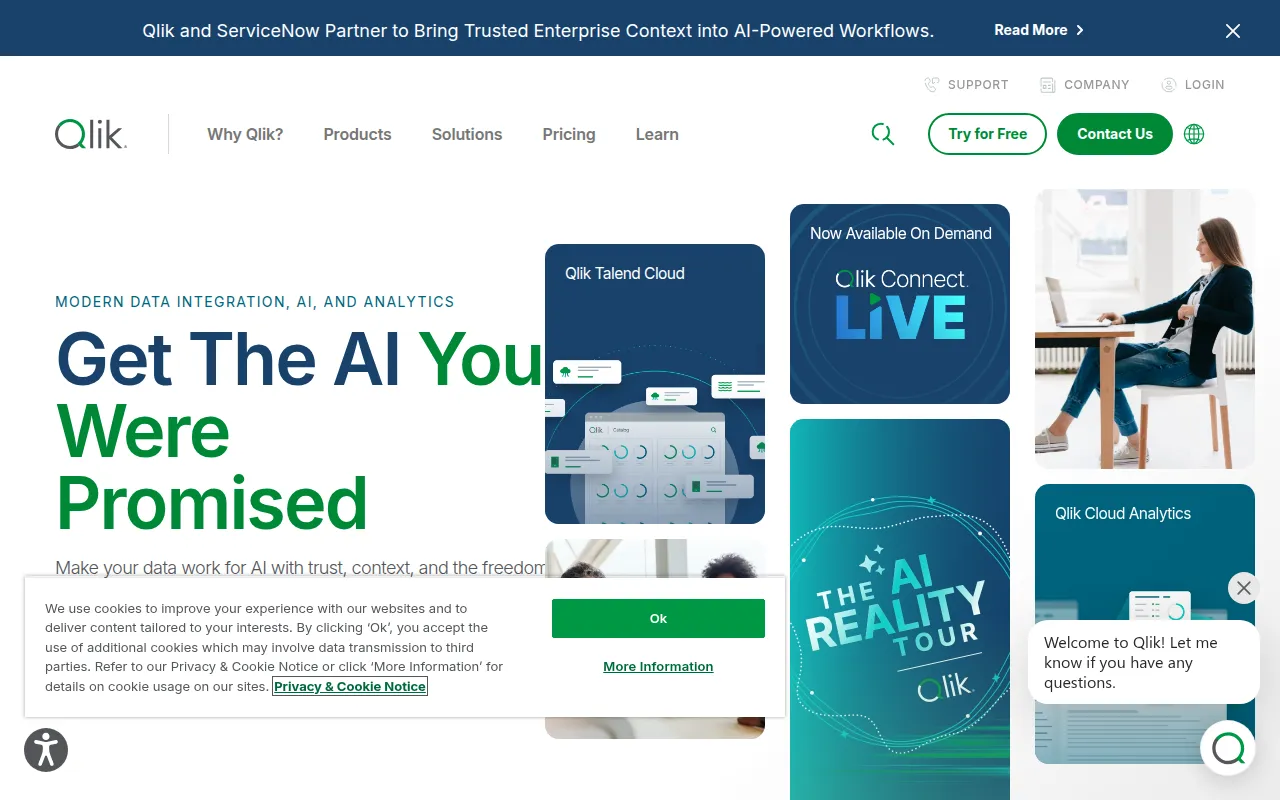
Qlik is a suite for data integration and business intelligence. It offers several specialized products, including Qlik Cloud Analytics for cloud-based access, Qlik Sense for on-premises needs, and Qlik Talend Cloud for managing data foundations.
The software is designed for various users, from small businesses to large enterprises. It helps teams unify disparate data sources and use AI to identify trends or forecast outcomes.
Buyers should confirm the technical resources required for implementation. It is also important to determine whether a cloud-based or on-premises deployment fits their security and infrastructure requirements.
Key Features
Data Integration and Quality
Connects and combines data from hundreds of sources to help create a trusted data foundation.
AI-Powered Analytics
Uses machine learning to help automate processes, analyze data, and derive insights.
Predictive AI
Includes Qlik Predict to help forecast business trends based on historical and current data.
Generative AI for Unstructured Content
Qlik Answers provides GenAI-driven answers based on unstructured business content.
Data Visualization
Supports the creation of dashboards and visualizations to identify trends and relationships.
Automation
Qlik Automate is designed to trigger actions across various SaaS applications based on data insights.
Use Cases
Multi-Source Data Integration
Combining data from AWS, Google, Microsoft, Snowflake, SAP, and other platforms into a unified view.
Predictive Trend Analysis
Using predictive AI to help anticipate future business outcomes.
Unstructured Data Querying
Using generative AI to find answers within unstructured documents and content.
Data Pipeline Automation
Automating the lifecycle of data warehouses and data lakes to create analytics-ready sets.
Integrations
- AWS
- Microsoft
- Snowflake
- SAP
- Databricks
- Cloudera
FAQ
What does Qlik analytics platform do?
- It integrates data from various sources and uses AI-powered analytics to provide business insights through dashboards, predictions, and generative AI answers.
Is this software suitable for small businesses?
- Yes, it is designed for small, mid-market, and enterprise companies, though technical requirements may mean small businesses need additional support for setup.
Can I try the software before purchasing?
- Yes, Qlik offers a free trial to allow users to test the capabilities.
What are the different deployment options?
- The platform provides Qlik Cloud Analytics for a SaaS deployment and Qlik Sense for organizations requiring an on-premises solution.
Source category: Data & Analytics
Source subcategory: Business Intelligence
More tools in Data & Analytics
Other published listings in the Data & Analytics category.


More tools in the Business Intelligence software type
Related listings that share the same software type for comparison and shortlisting.