AI TOOL PROFILE
FreightDesk.ai: LTL Freight Management Software

- Operations
- Freight Management
- Logistics companies
- Shipping companies
- Freight carriers
- Freight data teams
Pricing
Pricing includes a free tier, with paid plans available at €15 and €30 per month.
At a glance
- Best for
- Logistics companies, Shipping companies, Freight carriers, Freight data teams
- Key use cases
- LTL Shipment Coordination, Carrier Pricing Comparison, Shipper Self-Service, AI-Driven Data Analysis
- Official website
- Visit FreightDesk.ai official website
How AI is used
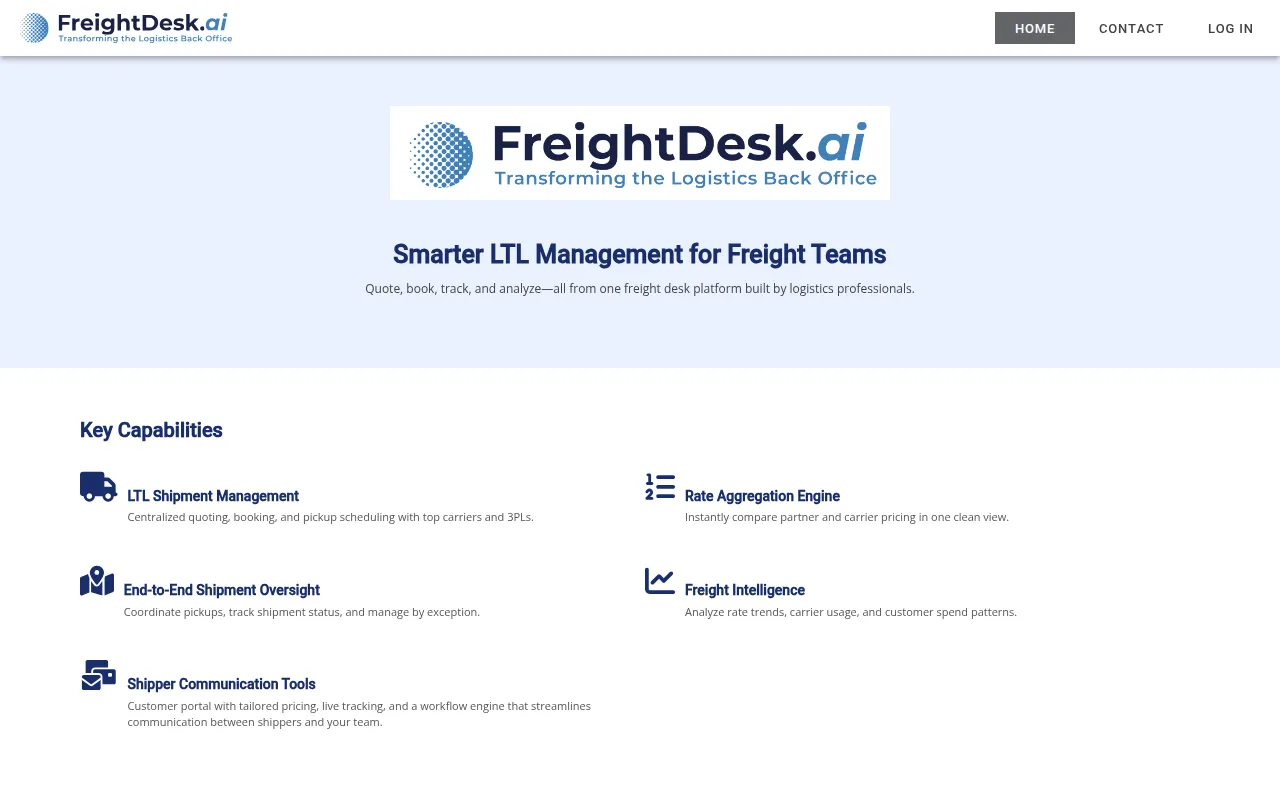
FreightDesk.ai is a freight management platform for logistics professionals to manage the lifecycle of LTL shipments. It provides tools for quoting, booking, and tracking shipments, which may help teams coordinate with carriers and 3PLs from a single interface.
The software is designed for freight carriers, shipping companies, and logistics teams. It includes a rate aggregation engine that allows users to compare partner and carrier pricing in one view, and a customer portal to support shipper communication.
Additionally, the platform supports building custom AI assistants by connecting company data and integrating with AI models such as ChatGPT, Claude, and Mistral.
Buyers should confirm if the specific carrier integrations they require are supported and evaluate whether the tiered pricing plans align with their shipment volume.
Key Features
LTL Shipment Management
Supports centralized quoting, booking, and pickup scheduling with carriers and 3PLs.
Rate Aggregation Engine
Provides a view to compare different partner and carrier pricing.
Shipment Oversight
Supports coordinating pickups, tracking status, and managing shipments by exception.
Freight Intelligence
Allows for the analysis of rate trends, carrier usage, and customer spend patterns.
Shipper Communication Tools
Includes a customer portal with tailored pricing and live tracking.
Custom AI Assistant Builder
Supports connecting company data to AI models like Mistral, ChatGPT, and Claude.
Use Cases
LTL Shipment Coordination
Managing the process of quoting and booking LTL freight across multiple carriers.
Carrier Pricing Comparison
Using a centralized engine to compare various carrier rates for shipment planning.
Shipper Self-Service
Providing customers with a portal for live tracking and tailored pricing updates.
AI-Driven Data Analysis
Building custom AI assistants using company shipment data to support decision making.
FAQ
What does FreightDesk.ai do?
- It is a platform for LTL shipment management that supports quoting, booking, tracking, and carrier rate aggregation.
Can you build custom AI tools with FreightDesk.ai?
- Yes, the platform allows users to connect company data to AI models like ChatGPT, Claude, and Mistral to create custom assistants.
How much does FreightDesk.ai cost?
- The platform offers a free tier, as well as paid subscription plans priced at €15 and €30 per month.
Source category: Operations
Source subcategory: Freight Management
More tools in Operations
Other published listings in the Operations category.


More tools in the Freight Management software type
Related listings that share the same software type for comparison and shortlisting.


