AI TOOL PROFILE
FalkorDB Review: Multi-Tenant Graph Database for AI
- Data and Analytics
- Database
- AI architects
- Development teams
- Cybersecurity vendors
- Companies building agentic AI
Pricing
Pricing includes a Free plan, a Startup plan starting at $73 per 1GB per month, and a Pro plan starting at $350 per 8GB per month. Enterprise pricing is tailored.
At a glance
- Best for
- AI architects, Development teams, Cybersecurity vendors, Companies building agentic AI
- Key use cases
- Fraud Detection, Cybersecurity Threat Intelligence, Conversational AI Chatbots, Access Management
- Integrations
- Snowflake
- Official website
- Visit FalkorDB official website
How AI is used
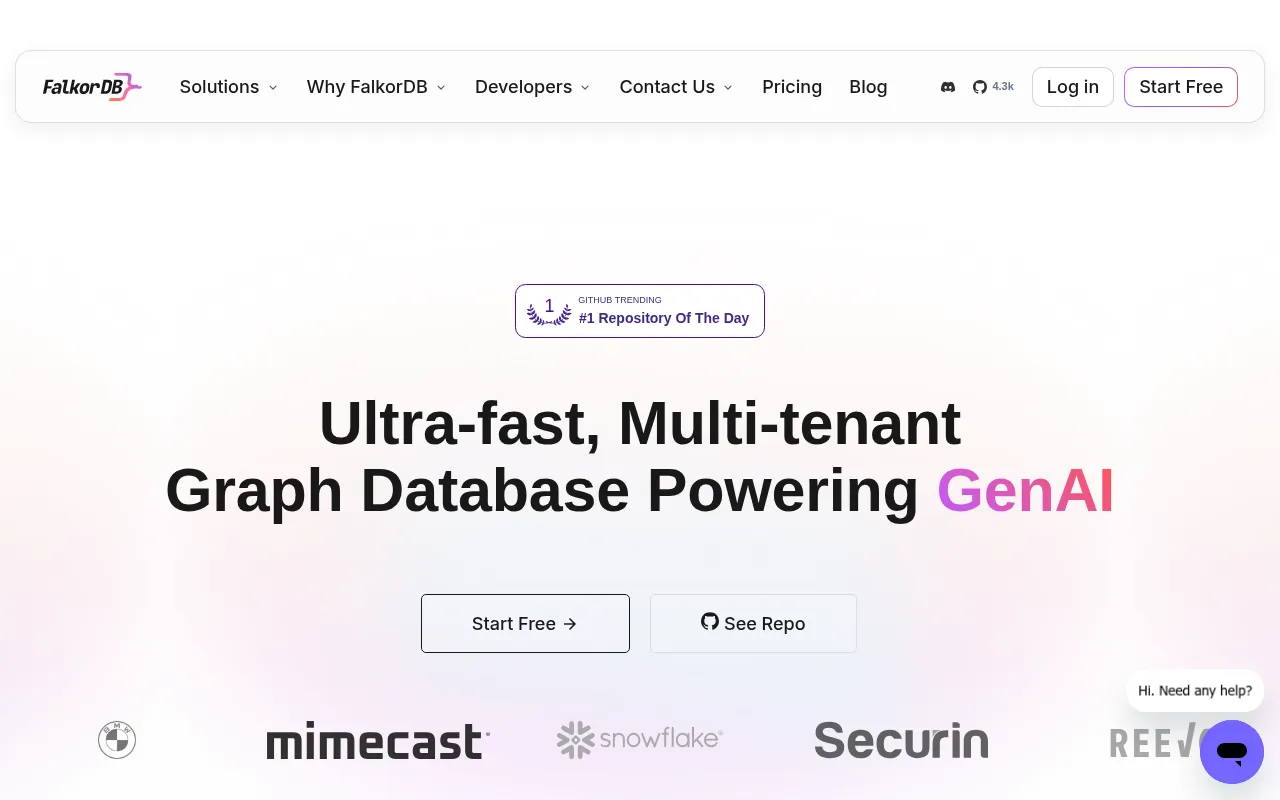
FalkorDB is a property graph database that uses sparse matrices and linear algebra to handle graph queries. It supports multi-tenancy, which allows for multiple isolated graphs within a single instance.
The software is designed for developers and AI architects who need to connect structured and unstructured data in real time. It supports GraphRAG (Retrieval-Augmented Generation), combining large language models with domain-specific knowledge graphs to help provide more accurate AI responses.
Buyers may use it for workloads requiring deep multi-hop traversals, such as cybersecurity threat intelligence or fraud detection. It supports the industry-standard Cypher query language.
Before choosing this tool, buyers should evaluate their specific memory requirements and confirm that a graph-based model fits their data structure better than a vector or relational database.
Key Features
Multi-tenant Architecture
Supports managing isolated graphs in a single instance to help reduce infrastructure overhead.
GraphRAG Support
Combines knowledge graphs with LLMs to provide context and may help reduce AI hallucinations.
Sparse Matrix Representation
Uses GraphBLAS and linear algebra for graph queries, which supports lower latency for deep traversals.
Cypher Support
Compatible with the industry-standard Cypher query language for interacting with graph data.
AVX Acceleration
Uses AVX acceleration to optimize performance and query execution speed.
Use Cases
Fraud Detection
Analyzing relationships between IPs, devices, and transactions to identify fraudulent patterns in real time.
Cybersecurity Threat Intelligence
Modeling relationships between CVEs, threat actors, and assets to perform multi-hop vulnerability analysis.
Conversational AI Chatbots
Integrating knowledge graphs for entity extraction and fact linking to help provide context-aware responses.
Access Management
Managing user permissions and access controls through relationship-based graph models.
Integrations
- Snowflake
FAQ
What is GraphRAG in FalkorDB?
- GraphRAG is a retrieval-augmented generation capability that combines LLMs with knowledge graphs to help provide more accurate and relevant AI responses.
How does FalkorDB handle multi-tenancy?
- It natively supports multi-tenant environments, which helps users manage multiple isolated graphs within a single instance.
Which pricing plan is intended for production environments?
- The Pro plan (starting at $350/8GB/month) includes features such as Cluster Deployment, High Availability, and Multi-zone Deployment.
Source category: Data & Analytics
Source subcategory: Database
More tools in Data & Analytics
Other published listings in the Data & Analytics category.


More tools in the Database software type
Related listings that share the same software type for comparison and shortlisting.