AI TOOL PROFILE
Fair Supply Review: ESG Compliance and Supply Chain Risk Software

- Operations
- Compliance Management
- Mid-market companies
- Enterprise companies
- Procurement professionals
- Sustainability and ESG leads
- Compliance and legal officers
Pricing
Pricing was not clearly available from the provided evidence. The company offers Foundational, Professional, Enterprise, and Custom tiers. Buyers should confirm current pricing on the vendor website.
At a glance
- Best for
- Mid-market companies, Enterprise companies, Procurement professionals, Sustainability and ESG leads, Compliance and legal officers
- Key use cases
- Modern Slavery Due Diligence, Carbon Footprint Reporting, Biodiversity Impact Tracking, Audit-Ready Disclosure Preparation, Trade Risk Evaluation
- Integrations
- CSV import, Excel import
- Official website
- Visit Fair Supply official website
How AI is used
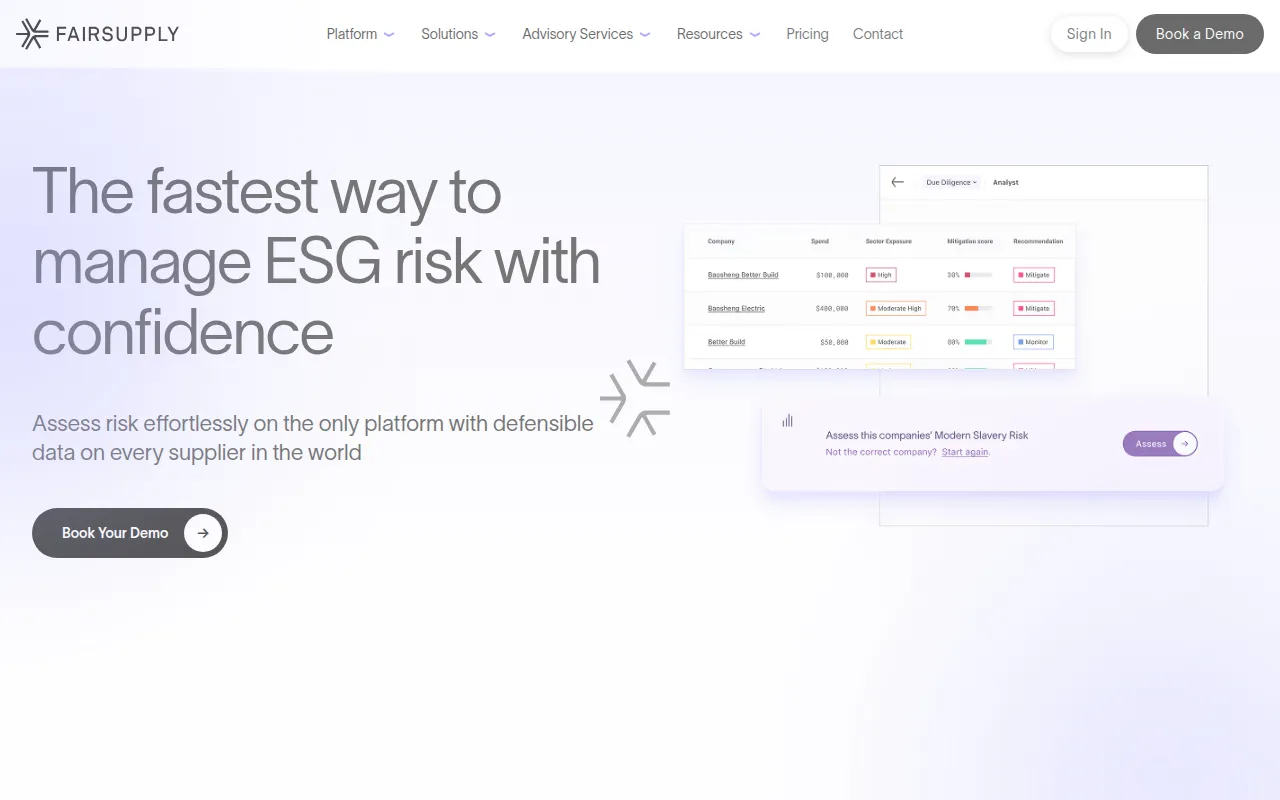
Fair Supply is a supply chain risk intelligence platform designed to help businesses manage ESG compliance. It supports identifying risks related to modern slavery, carbon emissions, biodiversity, and trade tariffs, with visibility up to ten tiers deep into the supply chain.
The software is designed for procurement, sustainability, and legal professionals who need to produce audit-ready reports. It uses economic modeling and global datasets to provide a baseline of risk based on supplier names and spend data.
Users may engage with higher-risk suppliers through customized self-assessment questionnaires (SAQs) and track mitigation progress over time. The platform supports reporting aligned with several global frameworks, including TCFD, GRI, and the GHG Protocol.
Buyers should confirm that the platform meets their specific needs, as pricing is personalized based on the chosen tier and complexity of the business requirements.
Key Features
Multi-Tier Supplier Analysis
Maps and assesses ESG risks across up to 10 tiers of the supply chain using Multi-Regional Input-Output (MRIO) modeling.
Automated Risk Assessment
Identifies potential risks across modern slavery, carbon emissions, and biodiversity based on supplier spend and geography.
ESG Compliance Reporting
Generates reports aligned with TCFD, CDP, IFRS S2, ESRS, and GRI frameworks.
Scope 1, 2, and 3 Emissions Modeling
Includes calculators for operational emissions and automated screening for value chain emissions.
Supplier Engagement Tools
Supports the deployment of pre-built and customized self-assessment questionnaires (SAQs) to suppliers.
Tariff Calculator
Evaluates the potential impact of global trade policy shifts on supply chain costs.
Human-in-the-Loop AI
Uses AI to map and classify supplier connections, which are audited and refined by human experts.
Use Cases
Modern Slavery Due Diligence
Identifying human rights risks across global supply chains to meet regulatory reporting obligations.
Carbon Footprint Reporting
Establishing a Scope 3 emissions baseline using spend data to support decarbonization strategies.
Biodiversity Impact Tracking
Measuring the environmental impact of the supply chain to support regulatory compliance.
Audit-Ready Disclosure Preparation
Creating a record of risk assessments and mitigation activities for boards and regulators.
Trade Risk Evaluation
Using the tariff calculator to understand how trade policy shifts may affect procurement costs.
Integrations
- CSV import
- Excel import
FAQ
What data is needed to start using Fair Supply?
- Users generally need a list of suppliers and the annual spend associated with each to assess risks across multiple categories and tiers.
Which ESG frameworks does Fair Supply support?
- The platform's outputs are aligned with TCFD, CDP, IFRS S2, ESRS, and GRI frameworks.
How does the platform handle Scope 3 emissions?
- Fair Supply uses Environmentally Extended Input-Output (EEIO) modeling to estimate Scope 3 emissions based on spend, sector, and geography.
Who is Fair Supply designed for?
- It is designed for procurement, ESG, compliance, and investment professionals, particularly those with formal reporting obligations.
Source category: Operations
Source subcategory: Compliance Management
More tools in Operations
Other published listings in the Operations category.


More tools in the Compliance Management software type
Related listings that share the same software type for comparison and shortlisting.


