AI TOOL PROFILE
Docxonomy: AI Search and Data Platform

- Data and Analytics
- AI Search
- Enterprise companies
- Mid-market companies
- Organizations with large amounts of unstructured data
- Highly regulated industries
Pricing
Pricing was not clearly available from the provided evidence. Buyers should confirm current pricing on the vendor website.
At a glance
- Best for
- Enterprise companies, Mid-market companies, Organizations with large amounts of unstructured data, Highly regulated industries
- Key use cases
- SOP Translation, Regulatory Documentation Automation, Legacy System Archiving, Global Labeling, Agency Inquiry Response
- Integrations
- Office export, PDF export, HTML export, XML export, JSON export
- Official website
- Visit docxonomy official website
How AI is used
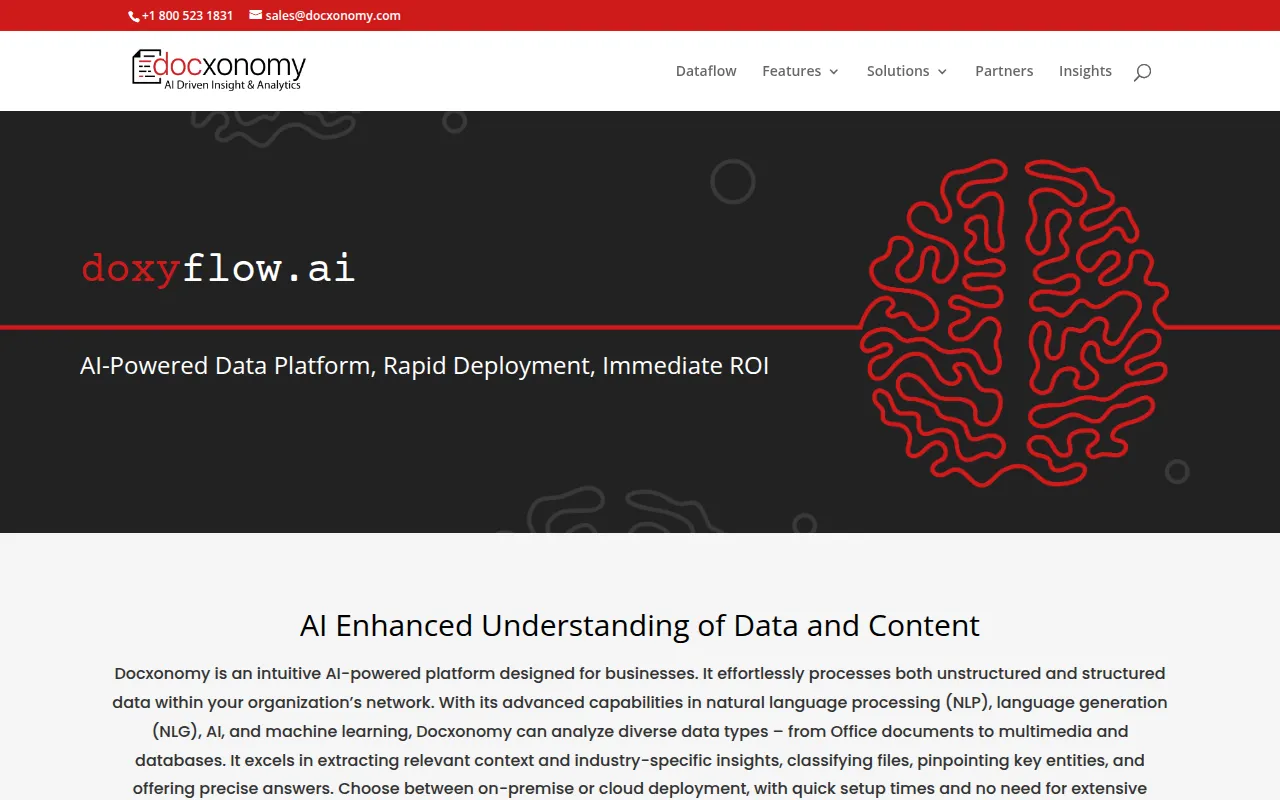
Docxonomy is a data platform that uses natural language processing (NLP) and machine learning to help businesses manage structured and unstructured information. It is designed to index data from various repositories, allowing users to search through text, images, and videos to find specific insights.
The tool is designed for larger organizations and enterprises that handle complex datasets, such as those in the life sciences sector. It supports tasks like file classification, entity extraction, and the generation of new content based on existing internal knowledge.
Buyers can choose between cloud or on-premise deployment. Because the software involves technical implementation and focuses on enterprise-scale dataflows, buyers should confirm how the platform integrates with their specific internal repositories and document formats.
Key Features
AI Search
Indexes structured and unstructured data across repositories to locate information across text, images, and video.
Content Generation
Uses large language models to produce drafts and new content by repurposing existing organizational data.
File Classification
Categorizes and labels files to help organize large volumes of corporate data.
Dataflow Processing
Allows users to configure multi-step AI workflows to transform raw data into formatted outputs.
Language Translation
Provides AI-driven translation for global content accessibility and technical documentation.
Similarity Analysis
Identifies semantic relationships between pieces of content using vector analysis.
Use Cases
SOP Translation
Supporting the translation of Standard Operating Procedures across different languages.
Regulatory Documentation Automation
Assisting with the automation of eTMF and eCTD processes for pharmaceutical and life science reviews.
Legacy System Archiving
Helping organizations retain and access content from decommissioned legacy systems.
Global Labeling
Supporting the generation and management of product labeling content.
Agency Inquiry Response
Helping teams locate specific data points across repositories to respond to agency requests.
Integrations
- Office export
- PDF export
- HTML export
- XML export
- JSON export
FAQ
What does Docxonomy do?
- Docxonomy is an AI platform that indexes and analyzes structured and unstructured data, providing tools for search, file classification, and AI-driven content generation.
Who is this software best for?
- It is designed for mid-market and enterprise-level companies, particularly those in regulated industries like life sciences that handle vast amounts of documentation.
Can it be installed locally?
- Yes, Docxonomy supports both on-premise and cloud deployment options.
What types of files can it analyze?
- The platform can process diverse data types, including Office documents, databases, images, and videos.
Source category: Data & Analytics
Source subcategory: AI Search
More tools in Data & Analytics
Other published listings in the Data & Analytics category.


More tools in the AI Search software type
Related listings that share the same software type for comparison and shortlisting.