AI TOOL PROFILE
Anjuna: Confidential Computing Platform

- Security
- Confidential Computing
- Enterprise companies
- Mid-market companies
- Financial services institutions
- Government agencies
- Blockchain and Web3 companies
- SaaS and software providers
Pricing
Pricing was not clearly available from the provided evidence. A free 30-day trial is available on AWS, Azure, or Google Cloud. Buyers should confirm current pricing on the vendor website.
At a glance
- Best for
- Enterprise companies, Mid-market companies, Financial services institutions, Government agencies, Blockchain and Web3 companies
- Key use cases
- Mainframe Offloading, Secure AI Collaboration, Protection of Digital Assets, Regulatory Compliance, SaaS IP Protection
- Integrations
- AWS Nitro Enclaves, Microsoft Azure Confidential Computing, Google Cloud
- Official website
- Visit anjuna official website
How AI is used
Anjuna is a security platform designed for confidential computing. It allows businesses to run applications in public clouds—including AWS, Azure, and Google Cloud—by using hardware-rooted Trusted Execution Environments (TEEs) to isolate code, data, and secrets at runtime.
The software is intended for regulated industries such as financial services, government agencies, and blockchain companies. It also supports software providers and SaaS vendors who seek to provide secure environments for AI models and proprietary IP.
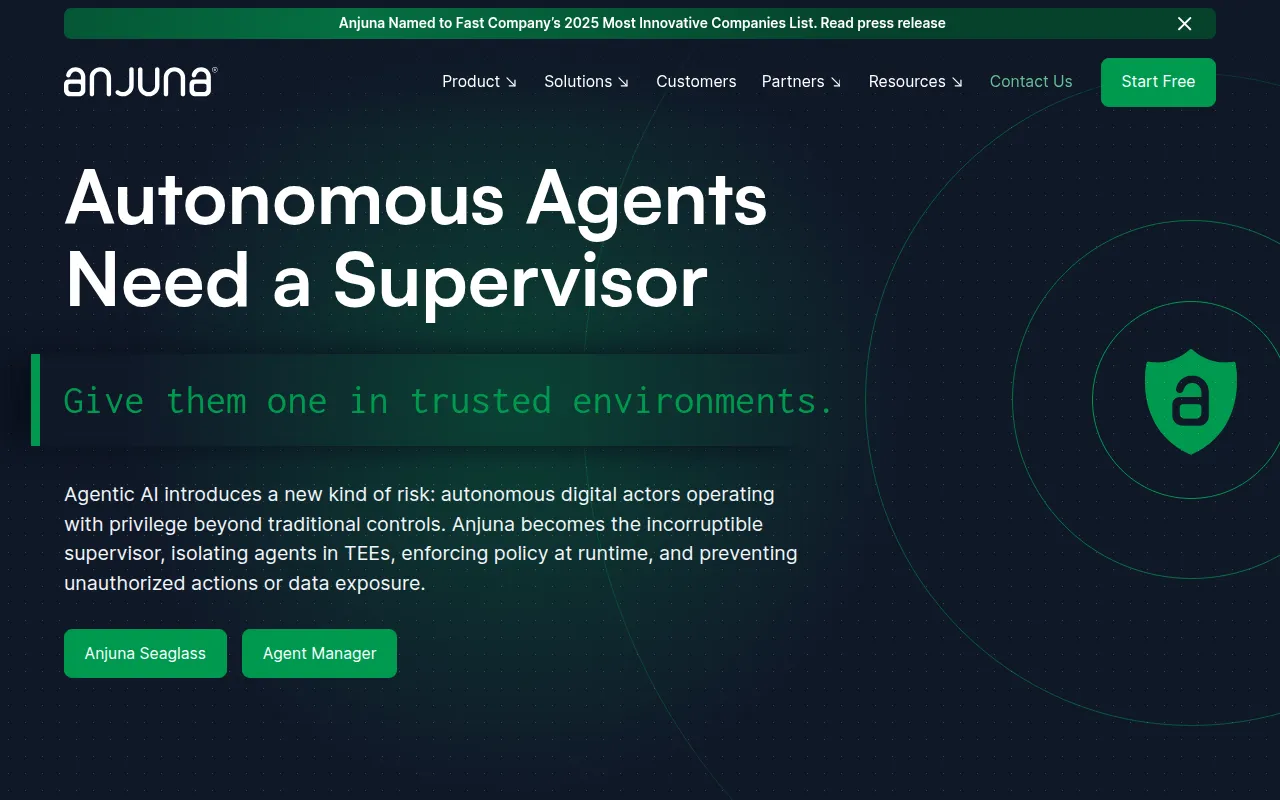
Beyond application isolation, Anjuna includes tools for AI data collaboration and the supervision of autonomous AI agents. This supports processing sensitive data and running AI workloads using cryptographic attestation to verify the chain of trust.
Buyers should confirm that their cloud infrastructure supports the necessary hardware-rooted TEEs and determine if their compliance requirements necessitate data-in-use encryption.
Key Features
Hardware-rooted TEEs
Creates secure enclaves that isolate code, data, and secrets at runtime to help prevent unauthorized access.
Three-state Data Encryption
Supports encryption for data at rest, in transit, and while being processed (data-in-use).
Cryptographic Attestation
Verifies the identity of code and infrastructure before applications boot or access secrets.
AI Data Fusion Clean Room
Provides a private environment for multi-party data collaboration and AI processing without exposing raw inputs.
Multi-Cloud Support
Designed to run applications across AWS, Azure, and Google Cloud without requiring code modifications.
Agentic AI Supervision
Isolates autonomous AI agents in TEEs and enforces runtime policies to help prevent unauthorized actions.
Use Cases
Mainframe Offloading
Supports moving operational data stores from mainframes to the cloud to help reduce costs while maintaining data privacy.
Secure AI Collaboration
Using clean rooms to combine proprietary data and AI models from multiple parties for joint processing.
Protection of Digital Assets
Securing validator nodes and private keys in blockchain infrastructure.
Regulatory Compliance
Helps organizations meet GDPR, PCI DSS, or data sovereignty requirements by protecting data-in-use.
SaaS IP Protection
Allows software providers to let customers self-host apps in secure enclaves to protect the vendor's AI-powered IP.
Integrations
- AWS Nitro Enclaves
- Microsoft Azure Confidential Computing
- Google Cloud
FAQ
What is Anjuna's approach to confidential computing?
- Anjuna uses hardware-rooted Trusted Execution Environments (TEEs), or secure enclaves, to isolate code, data, and secrets at runtime, ensuring data is encrypted even while being processed.
Does Anjuna require applications to be rewritten?
- No, Anjuna is designed to run traditional and cloud-native applications on leading public clouds without requiring code changes.
How does Anjuna secure autonomous AI agents?
- It isolates agents and MCP servers in TEEs, enforces runtime policies, and uses hardware-rooted attestation to help prevent memory poisoning and identity spoofing.
Is there a trial available for Anjuna?
- Yes, a free 30-day trial is available for use on AWS, Azure, or Google Cloud.
Source category: Security
Source subcategory: Confidential Computing
More tools in Security
Other published listings in the Security category.


