AI TOOL PROFILE
Ripik AI: Computer Vision AI Platform for Industrial Monitoring

- Software Development
- Computer Vision
- Industrial enterprises
- Manufacturing companies in heavy industry
- Large-scale plant operations
Pricing
Pricing was not clearly available from the provided evidence. Buyers should confirm current pricing on the vendor website.
At a glance
- Best for
- Industrial enterprises, Manufacturing companies in heavy industry, Large-scale plant operations
- Key use cases
- Raw Material Analysis, Equipment Health Monitoring, Conveyor Belt Monitoring, Process Stabilization
- Integrations
- WhatsApp, SCADA, L2 systems, NVR connectors
- Official website
- Visit Ripik AI official website
How AI is used
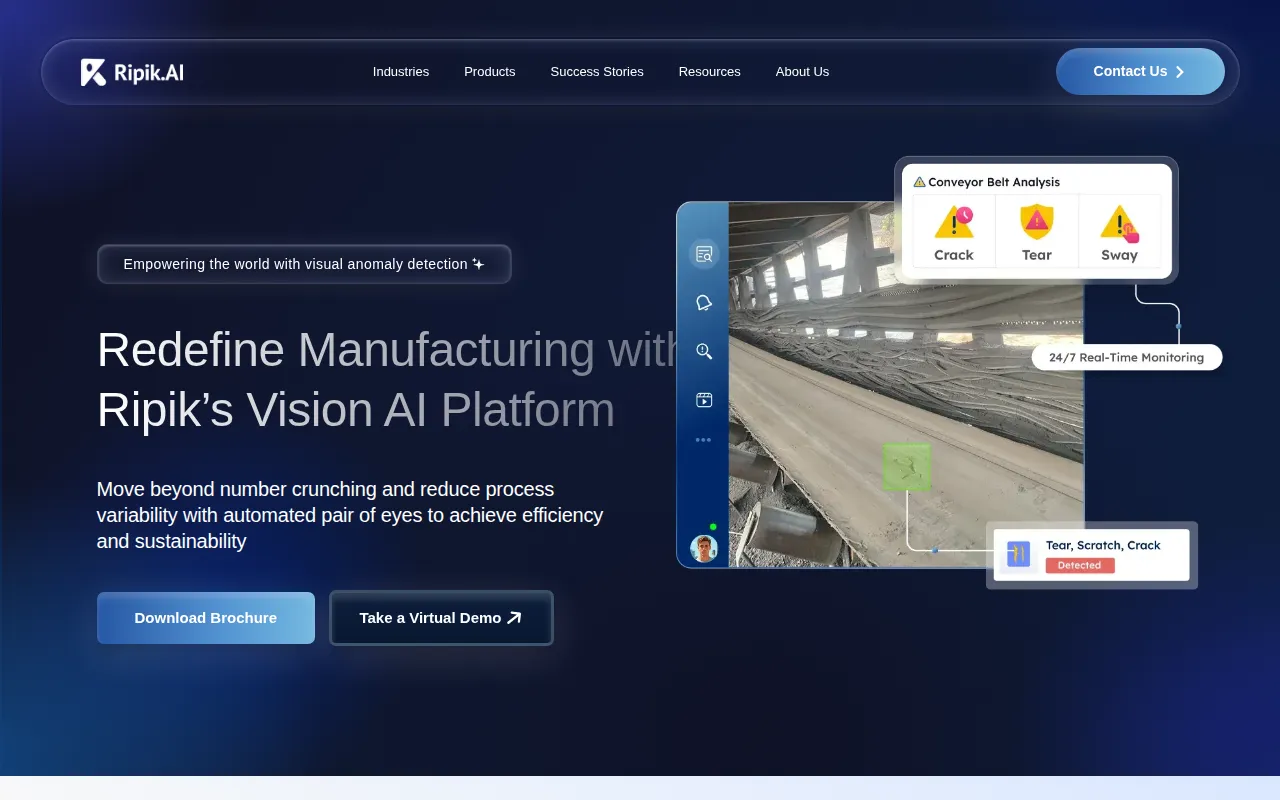
Ripik AI provides a computer vision platform for industrial settings, specifically for the steel, cement, aluminum, power, and chemical sectors. The system uses Vision AI Agents to monitor video feeds 24/7 to identify irregularities in industrial operations.
The software allows users to deploy and manage multiple AI agents across different plants through a centralized platform. It supports various monitoring tasks, including measuring raw material size and moisture, as well as tracking equipment health such as furnace hotspots and conveyor belt wear.
Buyers should confirm how the deployment process aligns with their existing camera and NVR setups, as the tool may require customized models for specific industrial processes.
Key Features
Vision AI Agents
AI models designed for 24/7 automated monitoring of materials and equipment with reported accuracy of 95% or higher.
Anomaly Detection
A system designed to identify visual irregularities and trigger alerts in real time when operational parameters are violated.
Ripik Vision Platform
A centralized management hub used to deploy, customize, and scale AI agents across industrial operations.
Infrared and Optical Analytics
Uses thermal imaging and optical data to measure molten metal levels and detect heat-related failures.
Closed-Loop Automation
Supports the integration of automated workflows to trigger corrective actions based on AI detections.
Use Cases
Raw Material Analysis
Monitoring coal and coke particle size distribution and detecting moisture levels on conveyor belts.
Equipment Health Monitoring
Detecting hotspots in electrical switchyards and monitoring furnace refractory wear to support predictive maintenance.
Conveyor Belt Monitoring
Identifying foreign objects, cracks, tears, and misalignments to help reduce unexpected downtime.
Process Stabilization
Using infrared analytics to monitor molten metal levels in furnaces to support stable operations.
Integrations
- SCADA
- L2 systems
- NVR connectors
FAQ
What does Ripik AI do?
- It provides a platform of AI agents that monitor industrial camera feeds to detect anomalies, measure material sizes, and track equipment health.
Which industries is Ripik AI designed for?
- It is designed for heavy industries, including steel, cement, aluminum, power, and chemical manufacturing.
Can it detect things other than visual objects?
- Yes, it uses infrared analytics to detect thermal anomalies, such as hotspots in switchyards or molten metal levels in furnaces.
Source category: Software Development
Source subcategory: Computer Vision
More tools in Software Development
Other published listings in the Software Development category.


More tools in the Computer Vision software type
Related listings that share the same software type for comparison and shortlisting.