AI TOOL PROFILE
LiveKit: Open Source Framework for AI Voice and Video Agents

- Software Development
- Communication API
- Software companies
- Enterprise developers
- AI engineering teams
Pricing
Pricing follows a freemium model with a free Build plan. Paid options include the Ship plan starting at $50/mo and the Scale plan starting at $500/mo, with custom Enterprise pricing available.
At a glance
- Best for
- Software companies, Enterprise developers, AI engineering teams
- Key use cases
- Voice AI Agent Deployment, Telephony Integration, Agent Performance Monitoring, Multimodal Interface Development
- Official website
- Visit LiveKit official website
How AI is used
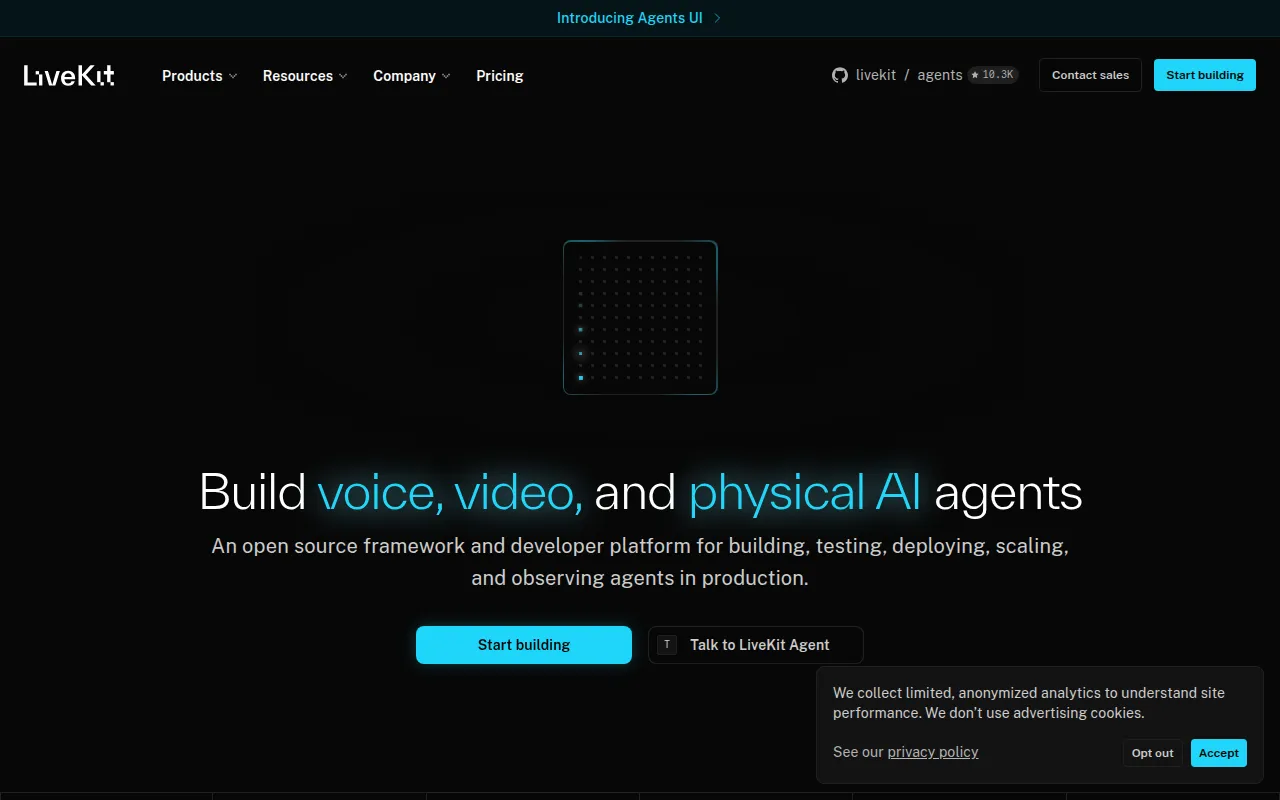
LiveKit is a developer platform that provides infrastructure for creating AI agents capable of real time interaction. It combines an open source framework with a managed cloud service to handle media transport and scaling.
The platform is designed for developers building multimodal AI, supporting the development lifecycle from coding and testing to production deployment. It provides tools for the inference of language, speech-to-text (STT), and text-to-speech (TTS) models.
Buyers can host agents that interact via web, mobile, or phone systems. The cloud version manages the runtime infrastructure, including routing and autoscaling, while the open source version supports self-hosting.
Prospective users should confirm their requirements for concurrency and session minutes, as different plan tiers provide different limits on agent deployments and concurrent sessions.
Key Features
Real time Inference
Supports routing for LLM, STT, and TTS models.
Telephony SIP Integration
Supports connecting AI agents to phone systems for inbound and outbound calling.
Agent Observability
Provides tools to review session recordings, transcripts, and trace spans to monitor performance.
Global Cloud Network
A distributed mesh of media servers designed for voice and video transport.
Conversational Intelligence
Includes models for interruption handling and end-of-turn detection.
Open Source SDKs
Provides server-side SDKs in Python and TypeScript for custom agent logic.
Use Cases
Voice AI Agent Deployment
Building and hosting AI agents that interact with users via voice in real time.
Telephony Integration
Connecting AI agents to phone numbers for automated call handling using SIP support.
Agent Performance Monitoring
Using observability tools to inspect conversation logs and latency to adjust agent behavior.
Multimodal Interface Development
Creating agent interfaces that support voice and video across web, iOS, and Android platforms.
FAQ
Does LiveKit have a free version?
- Yes, LiveKit offers a free Build plan that includes 1,000 agent session minutes monthly and one free US local phone number.
Can I host LiveKit on my own servers?
- Yes, the LiveKit Agents framework and media server are open source and can be run locally or hosted on your own infrastructure.
What is the difference between a Ship and Scale plan?
- The Ship plan starts at $50/mo and adds team collaboration and email support, while the Scale plan starts at $500/mo and adds role-based access, metrics export APIs, and region pinning.
Source category: Software Development
Source subcategory: Communication API
More tools in Software Development
Other published listings in the Software Development category.


More tools in the Communication API software type
Related listings that share the same software type for comparison and shortlisting.