AI TOOL PROFILE
Flipner AI: Voice-to-Text Writing Assistant

- Productivity
- AI Writing Assistant
- Blog authors
- Copywriters
- Content creators
- News writers
- Influencers
Pricing
Pricing starts at $12/month for the Standard plan, with a Pro plan at $32/month and custom Enterprise options. Lifetime deals are available for $119 and $279.
At a glance
- Best for
- Blog authors, Copywriters, Content creators, News writers, Influencers
- Key use cases
- Blog Post Drafting, Social Media Content Creation, Journalistic Gathering, Copywriting Brainstorming
- Official website
- Visit flipner ai official website
How AI is used
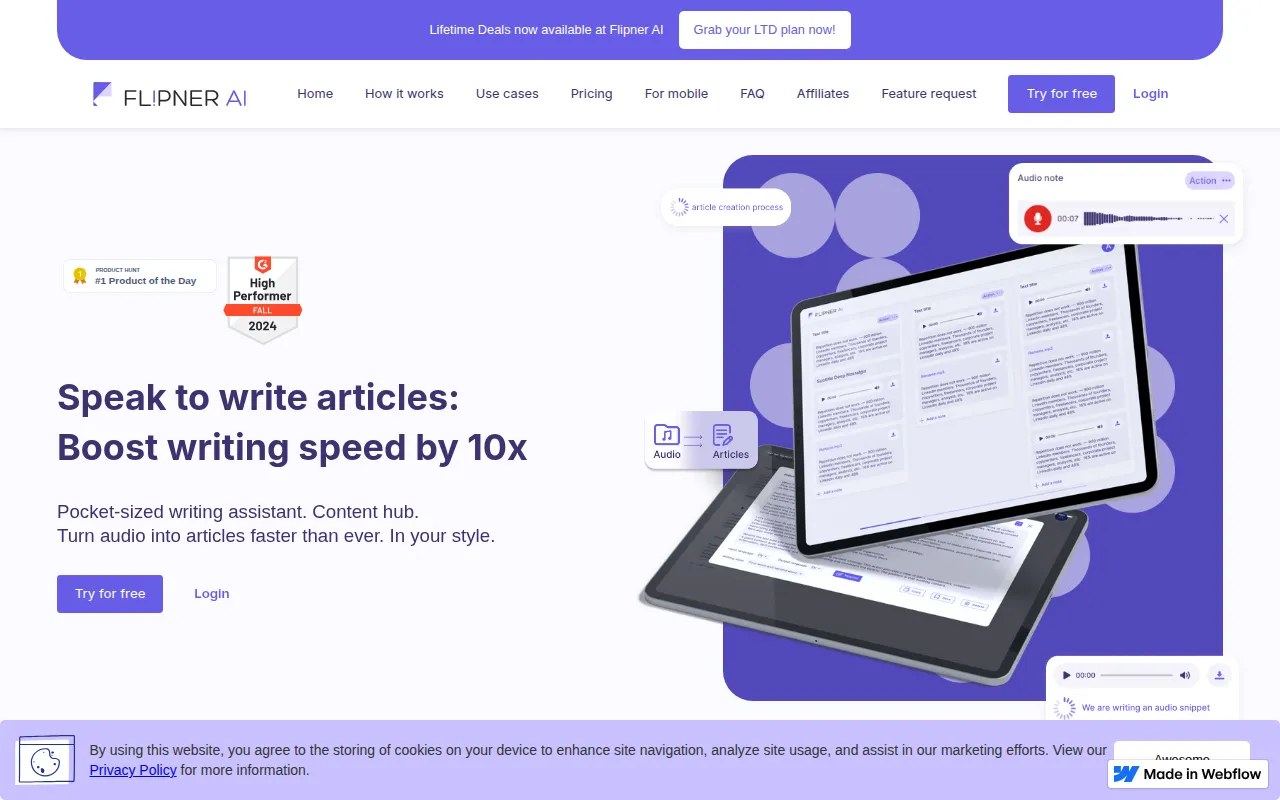
Flipner AI is a voice-to-text tool designed to help users create articles by speaking. It functions as a content hub where users can record audio snippets, upload existing audio files, and organize them into cohesive pieces of writing.
The software is intended for people who produce written content, such as blog authors, copywriters, and news writers. It supports over 30 languages and provides stylistic options to adjust the tone of the output.
Buyers should confirm their monthly character requirements and audio recording needs, as these limits vary across the different pricing tiers. The tool provides a mobile-friendly interface for capturing audio.
Key Features
Voice-to-Text Conversion
Converts spoken audio snippets into written text to help create articles.
Multi-Language Support
Supports recording and conversion in over 30 languages, including English, Spanish, French, and German.
Stylistic Tones
Provides more than 10 different writing styles, such as journalistic, technical, or legal.
Content Hub Management
Supports storing, organizing, and editing both audio and text snippets.
Audio File Handling
Supports uploading audio files (up to 25 MB) and downloading files.
Use Cases
Blog Post Drafting
Dictating ideas into the app to capture thoughts and then structuring them into blog articles.
Social Media Content Creation
Recording audio snippets of ideas and combining them into posts for social accounts.
Journalistic Gathering
Collecting audio snippets in the field and compiling them into news reports or articles.
Copywriting Brainstorming
Using the tool as a repository for spoken ideas that can be rewritten into various professional styles.
FAQ
What languages does Flipner AI support?
- Flipner AI supports over 30 languages, including English, German, Spanish, French, Ukrainian, Italian, Polish, Arabic, and Hindi.
Can I upload my own audio files to Flipner AI?
- Yes, the tool supports uploading audio files, typically up to 25 MB and 15 minutes in length, depending on the plan.
Which plan should I choose based on usage?
- Users with light needs can start with the Free plan, while those requiring more AI-generated characters and longer audio storage may consider the Standard or Pro plans.
Source category: Productivity
Source subcategory: AI Writing Assistant
More tools in Productivity
Other published listings in the Productivity category.


More tools in the AI Writing Assistant software type
Related listings that share the same software type for comparison and shortlisting.


