AI TOOL PROFILE
Ekara: Digital Experience Monitoring

- Software Development
- Application Performance Monitoring
- Enterprise companies
- Mid-market companies
- Software companies
- IT Operations teams
- SRE and DevOps teams
Pricing
Ekara offers a freemium option and a free trial. Pricing was not clearly available from the provided evidence; buyers should confirm current pricing on the vendor website.
At a glance
- Best for
- Enterprise companies, Mid-market companies, Software companies, IT Operations teams, SRE and DevOps teams
- Key use cases
- Protecting Critical User Journeys, Post-Release Validation, Incident Triage, Enterprise App Supervision
- Integrations
- Ekara Connect API, Webhooks
- Official website
- Visit ekara official website
How AI is used
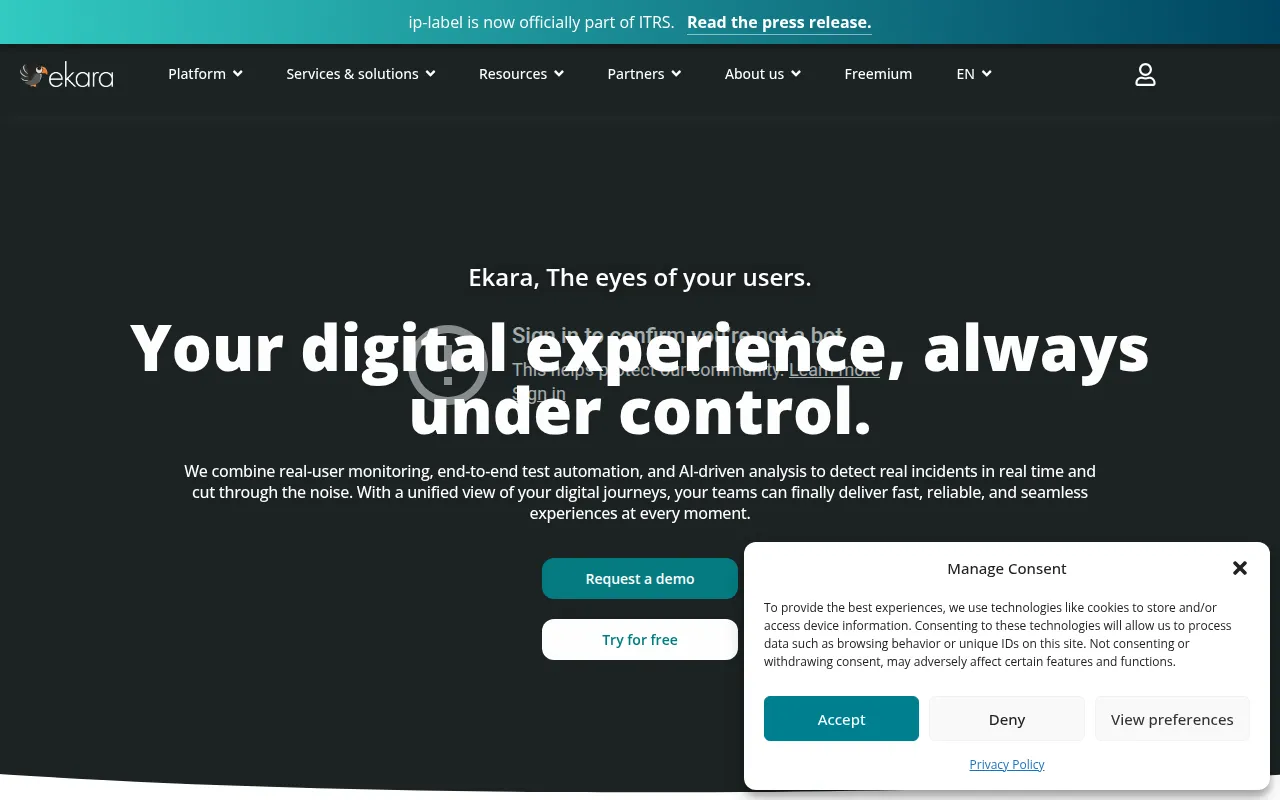
Ekara is a Digital Experience Monitoring (DEM) platform that combines Real User Monitoring (RUM) and Synthetic Transaction Monitoring (STM). It is designed for organizations that need to track how users interact with websites, mobile apps, and APIs in real time while running scripted checks to identify issues before they impact users.
The platform supports tracking Core Web Vitals such as LCP, INP, and CLS, and includes a no-code studio for creating monitoring journeys. It also provides monitoring for thick client applications and SaaS tools, which may be useful for organizations relying on legacy enterprise software.
Buyers should consider their deployment needs, as Ekara supports SaaS, hybrid cloud, and on-premise self-hosted options to meet security and data residency requirements. Technical teams should confirm if the instrumentation and sampling options align with their specific traffic volume.
Key Features
Real User Monitoring (RUM)
Captures field data from visitors to track Core Web Vitals and performance across different devices, browsers, and geographies.
Synthetic Transaction Monitoring
Uses scripted tests to simulate critical user journeys 24/7 to detect outages and availability issues proactively.
Unified Monitoring
Correlates RUM and synthetic data in a shared view to help teams prioritize incidents based on user impact.
Ekara Studio
A no-code environment for scripting and maintaining monitoring journeys.
AI Incident Guard
Designed to classify alerts and filter noise to identify relevant incidents.
Thick Client Monitoring
Tracks the performance of desktop enterprise applications such as SAP GUI and Oracle Forms.
API Monitoring
Monitors API availability and latency, including authentication steps and chained calls.
Use Cases
Protecting Critical User Journeys
Monitoring multi-step transactions such as login and checkout using synthetic checks for uptime and RUM for actual user experience.
Post-Release Validation
Using release markers to correlate deployments with shifts in Core Web Vitals or JavaScript errors.
Incident Triage
Identifying which user cohorts by ISP, country, or device are affected by a performance drop to support root cause analysis.
Enterprise App Supervision
Measuring the performance of thick client applications to identify if bottlenecks are in the workstation, network, or backend.
Integrations
- Ekara Connect API
- Webhooks
FAQ
What is the difference between Ekara's RUM and Synthetic monitoring?
- RUM captures data from actual visitors to show what is happening in real time, while Synthetic monitoring uses scripted tests to proactively check journeys 24/7, even without user traffic.
Does Ekara support on-premise deployment?
- Yes, Ekara offers on-premise and self-hosted deployment options for organizations with security, privacy, or data residency requirements.
How does Ekara handle Core Web Vitals?
- Ekara tracks field measurements for LCP, INP, and CLS at the 75th percentile (p75), allowing teams to segment data by device, browser, and geography.
Source category: Software Development
Source subcategory: Application Performance Monitoring
More tools in Software Development
Other published listings in the Software Development category.


More tools in the Application Performance Monitoring software type
Related listings that share the same software type for comparison and shortlisting.


Browse all Application Performance Monitoring software type tools