AI TOOL PROFILE
Authsignal: Passwordless Authentication and Adaptive MFA

- Security
- Identity and Access Management
- Mid-market companies
- Enterprise businesses
- FinTech and Financial Services
- Healthcare providers
- E-commerce platforms
Pricing
Professional plans start at $1,099 per month for up to 20,000 monthly active users. Enterprise plans use volume-based pricing. A 30-day free trial is available.
At a glance
- Best for
- Mid-market companies, Enterprise businesses, FinTech and Financial Services, Healthcare providers, E-commerce platforms
- Key use cases
- Preventing Account Takeovers, Risk-Based Step-Up Authentication, Digital Identity Verification, SMS Cost Optimization, Call Center Verification
- Integrations
- Amazon Cognito, Azure AD B2C, Auth0, Keycloak, Duende IdentityServer
- Official website
- Visit authsignal official website
How AI is used
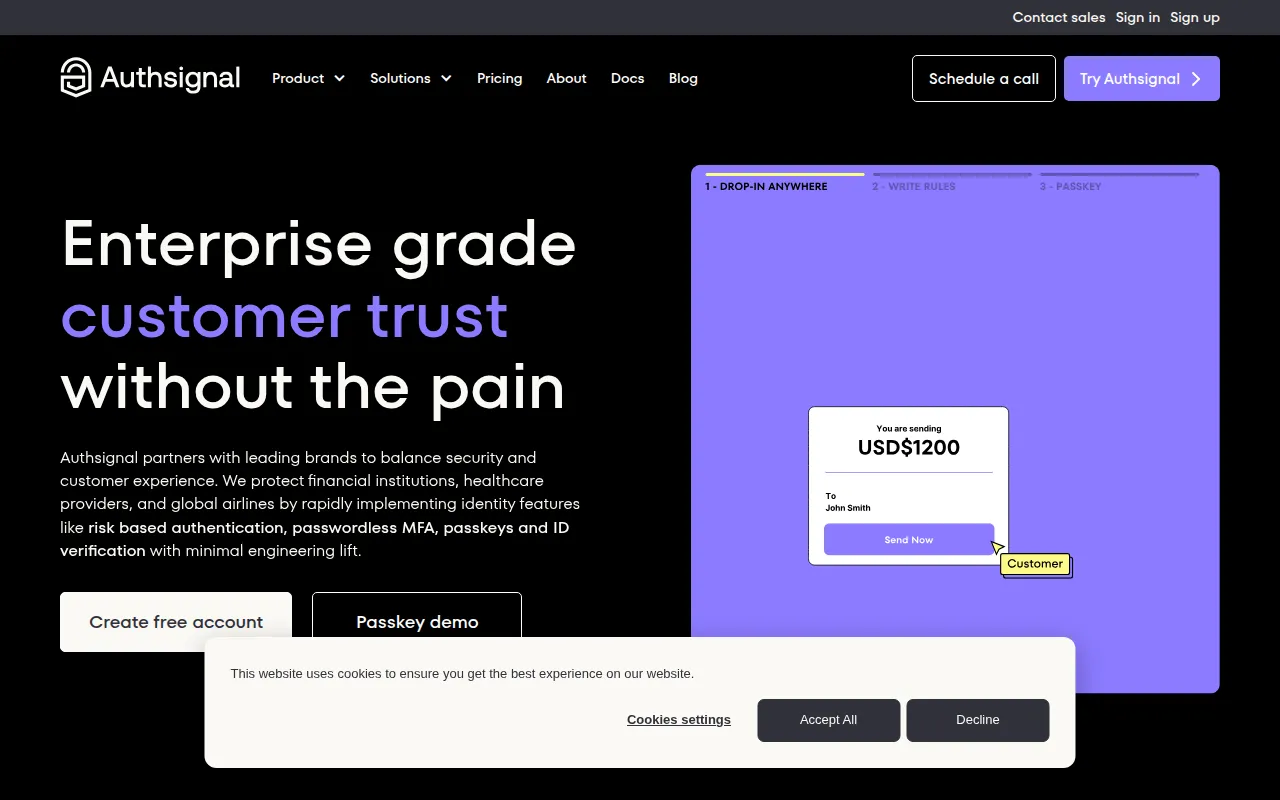
Authsignal is an authentication-as-a-service platform designed to add security layers to a business's existing identity provider. It focuses on reducing reliance on passwords through FIDO-certified passkeys and various multi-factor authentication (MFA) methods.
The tool is designed for mid-market and enterprise companies, including those in financial services, healthcare, e-commerce, and fintech. It provides implementation options ranging from pre-built UI components to custom APIs for design control.
Businesses can manage risk using a no-code rules engine that may trigger step-up authentication based on behavior or risk signals. The platform also supports identity checks, including biometric face and palm scanning and official ID document verification.
Buyers should confirm whether their current technical architecture supports the integration of a drop-in authentication layer and verify if the professional tier's user limits align with their monthly active user count.
Key Features
FIDO-certified Passkeys
Supports phishing-resistant, passwordless authentication using device-based biometrics.
Adaptive MFA
Applies multi-factor authentication selectively based on contextual risk factors such as device and location.
No-Code Rules Engine
A visual builder used to set fraud rules, trigger authentication steps, or block access based on risk signals.
Biometric Authentication
Supports identity verification via face matching and palm vein scanning.
Multi-Channel OTP
Delivers one-time passcodes via SMS, Email, and WhatsApp.
User Observability
Provides audit trails and a view of customer actions to help fraud teams diagnose security events.
Use Cases
Preventing Account Takeovers
Using phishing-resistant passkeys and adaptive rules to help protect B2C accounts from credential stuffing.
Risk-Based Step-Up Authentication
Requiring additional verification when risk signals are detected during sensitive transactions.
Digital Identity Verification
Verifying government-issued IDs and using live face matching for user onboarding.
SMS Cost Optimization
Replacing some SMS OTPs with WhatsApp OTPs or passkeys to manage operational costs.
Call Center Verification
Verifying caller identity through MFA workflows during phone-based customer service.
Integrations
- Amazon Cognito
- Azure AD B2C
- Auth0
- Keycloak
- Duende IdentityServer
- NextAuth.js
- ServiceNow
- Salesforce
- Amazon Connect
FAQ
How does Authsignal integrate with existing identity providers?
- It is designed as a drop-in solution that plugs into existing architectures, offering integrations with providers such as Amazon Cognito, Azure AD B2C, and Auth0.
What is the starting price for Authsignal?
- The Professional plan starts at $1,099 per month and supports up to 20,000 monthly active users (MAUs).
Does Authsignal offer a free trial?
- Yes, Authsignal provides a 30-day free trial with access to features including passkeys and the rules engine.
What are 'adaptive' MFA and 'step-up' authentication?
- Adaptive MFA applies authentication selectively based on risk signals, while step-up authentication increases the required security strength when a high-risk action is detected.
Source category: Security
Source subcategory: Identity & Access Management
More tools in Security
Other published listings in the Security category.


More tools in the Identity and Access Management software type
Related listings that share the same software type for comparison and shortlisting.


Browse all Identity and Access Management software type tools