AI TOOL PROFILE
Qubrid AI: AI Inference Platform for Developers

- Software Development
- AI Infrastructure
- Software Companies
- Enterprise Developers
- AI/ML Companies
Pricing
Usage-based pricing with credit packages starting at $5. Model costs range from $0.0001 per image to $5+ per 1M tokens, with separate hourly rates for GPU compute.
At a glance
- Best for
- Software Companies, Enterprise Developers, AI/ML Companies
- Key use cases
- Running Open AI Models via API, Deploying AI/ML Workloads, Prototyping AI Applications
- Official website
- Visit Qubrid AI official website
How AI is used
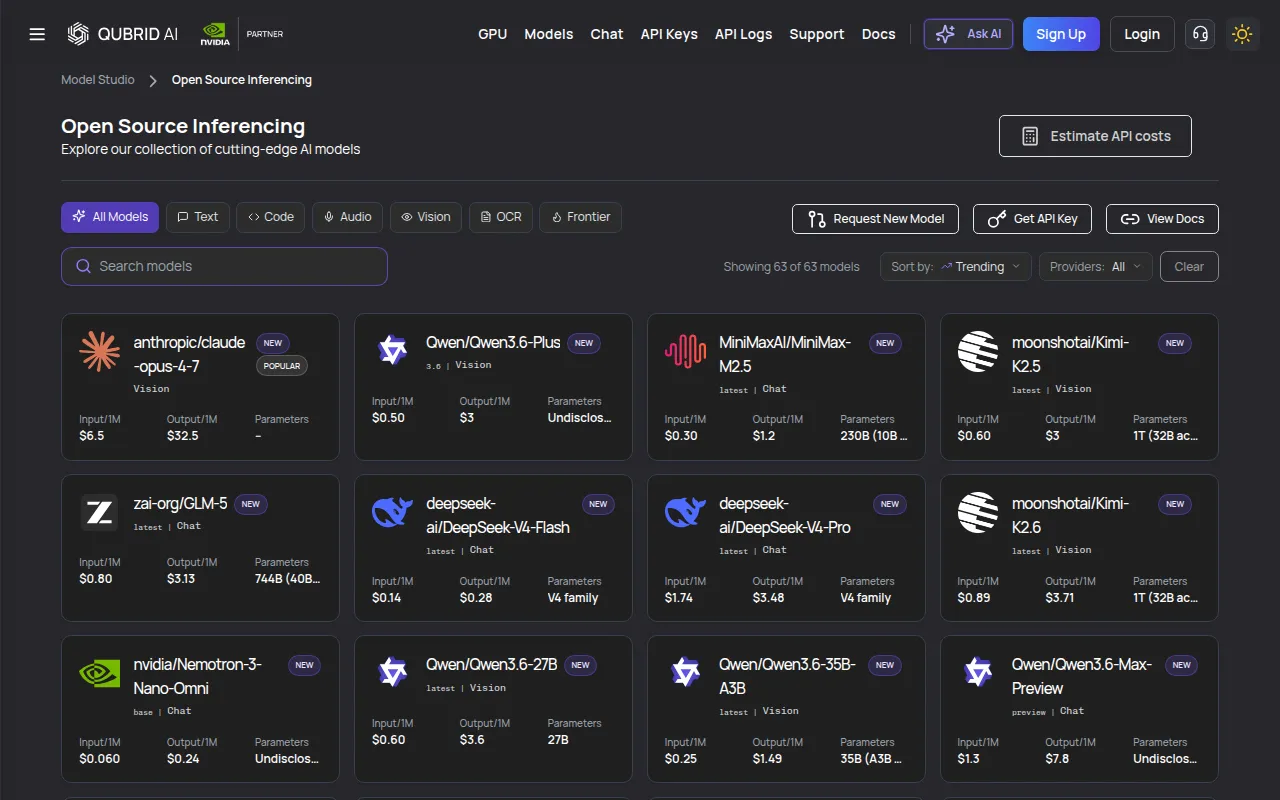
Qubrid AI is an inference-first platform for developers to run open AI models. It provides a single API to access 73 models covering text, code, image, audio, video, vision, and OCR tasks.
The platform is designed for enterprise developers and AI/ML companies. It supports technical needs ranging from API calls for model inferencing to deployments using GPU virtual machines and bare metal servers.
Beyond API access, the platform includes GPU compute options featuring NVIDIA A10G, H100, and A100 cards, which may help users deploy workloads such as AI agents or custom workflows. A free playground is available for testing models before adding credits.
Buyers should confirm if their specific technical requirements for GPU memory and vCPU align with the available on-demand and reserved server configurations.
Key Features
Open Model API
Provides a single API endpoint to run 73 different open AI models.
GPU Compute Options
Offers access to NVIDIA GPUs, including A10G, T4, L4, L40S, H200, A100, and H100.
Free Playground
A testing environment where users can try models before adding credits to their account.
Multi-Modal Support
Supports models for text, code, image, audio, video, vision, and OCR.
Credit Packages
Top-up options starting at $5 to fund API usage.
Use Cases
Running Open AI Models via API
Using a single interface to call various open-source models for text generation or image processing.
Deploying AI/ML Workloads
Hosting AI agents, ComfyUI, or n8n using GPU compute.
Prototyping AI Applications
Testing different model versions in the free playground before moving to a paid workflow.
FAQ
What is Qubrid AI used for?
- It is used by developers to run open AI models via an API and deploy AI/ML workloads using NVIDIA GPU compute options.
How does Qubrid AI pricing work?
- It uses a usage-based model where users can buy credit packages starting at $5. Costs are based on token usage for models and hourly rates for GPU compute.
Can I test models before paying?
- Yes, Qubrid AI provides a free playground where users can test models before adding credits.
Source category: Software Development
Source subcategory: AI Infrastructure
More tools in Software Development
Other published listings in the Software Development category.


More tools in the AI Infrastructure software type
Related listings that share the same software type for comparison and shortlisting.


