AI TOOL PROFILE
n1n: Unified LLM API Gateway

- Software Development
- AI Infrastructure
- Software companies
- Enterprise companies
- Mid-market companies
- AI developers
Pricing
Pricing was not clearly available from the provided evidence. Buyers should confirm current pricing on the vendor website.
At a glance
- Best for
- Software companies, Enterprise companies, Mid-market companies, AI developers
- Key use cases
- Model Switching, API Usage Management, Unified Billing, Global Application Deployment
- Official website
- Visit n1n official website
How AI is used
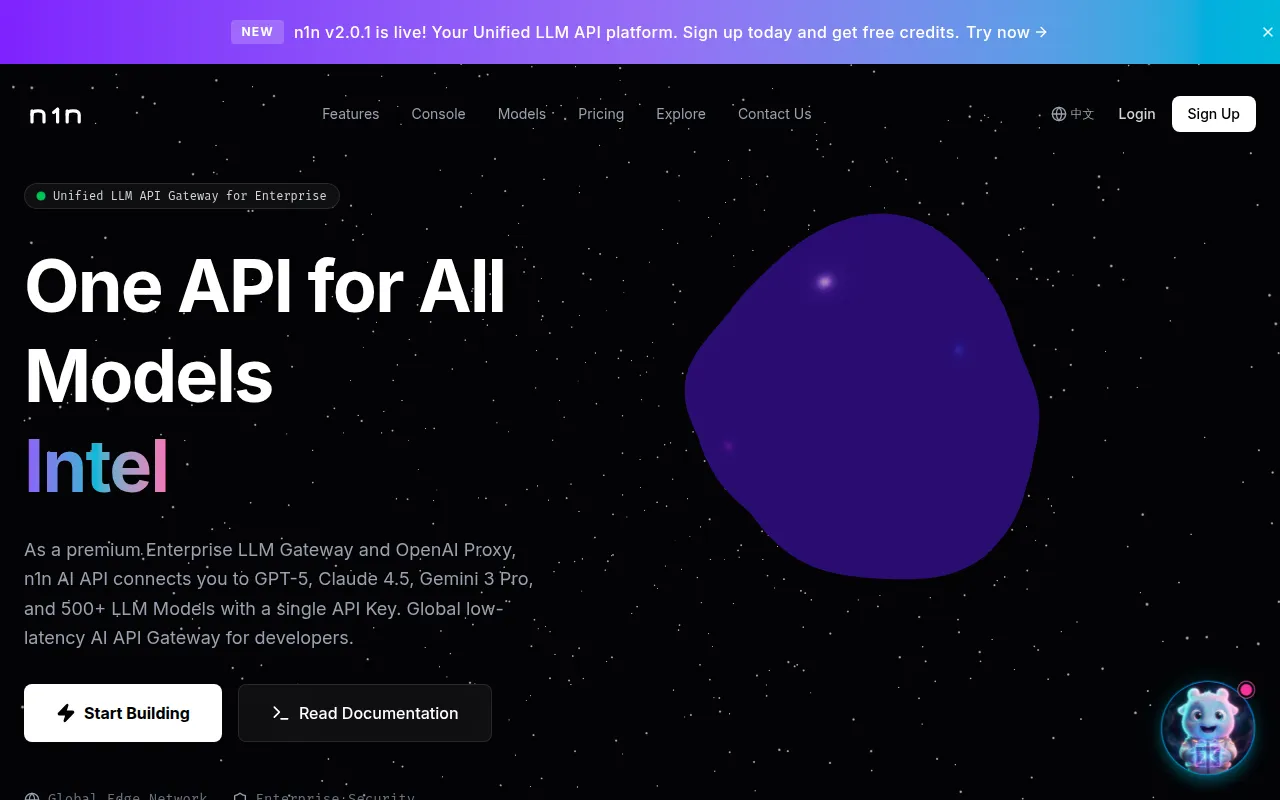
n1n acts as a gateway and proxy for Large Language Models (LLMs). Instead of managing separate accounts and API keys for every AI provider, users can access a variety of models—including those from OpenAI, Anthropic, and Google—through a single point of entry.
The service is designed for developers and enterprise teams who need flexibility in their AI stack. It utilizes a global edge network to help reduce latency for users in different regions.
Beyond connectivity, the platform provides tools for administrative oversight, such as sub-key management and quota settings. This may help operations managers control costs and monitor usage across different projects or team members.
Buyers should confirm whether their current security requirements align with the platform's SOC2 readiness and verify how the unified billing model fits into their internal accounting processes.
Key Features
Unified API Access
Provides a single API key to access over 500 different LLM models.
Global Edge Network
Uses 24 CN2 GIA nodes across 7 regions to support low-latency connectivity.
Granular Access Control
Supports issuing sub-keys with specific quotas, expiration dates, and model permissions.
High Availability Routing
Uses redundant routing designed to maintain service if an upstream model provider has an outage.
SOC2 Readiness
Includes data privacy and security features designed to support enterprise compliance standards.
Use Cases
Model Switching
Supporting the ability to switch between different AI models for specific tasks without changing core application code.
API Usage Management
Setting limits and quotas on sub-keys to help manage budget overruns across multiple developers.
Unified Billing
Consolidating multiple AI provider costs into a single statement for accounting.
Global Application Deployment
Using edge nodes to help reduce the time to first token for international users.
FAQ
What does n1n do?
- n1n acts as a gateway that allows developers to access hundreds of different AI models from various providers using one single API key and a standardized interface.
Can it help with AI cost management?
- Yes, it allows administrators to create sub-keys with specific quotas and limits, which may help reduce accidental overruns.
Is n1n suitable for enterprise security requirements?
- The platform is described as SOC2-ready and includes data privacy features designed for enterprise compliance.
Source category: Software Development
Source subcategory: AI Infrastructure
More tools in Software Development
Other published listings in the Software Development category.


More tools in the AI Infrastructure software type
Related listings that share the same software type for comparison and shortlisting.


