AI TOOL PROFILE
LitmusChaos: Open Source Chaos Engineering Platform

- Software Development
- DevOps Platform
- Software Companies
- Enterprise Companies
- SRE teams
- Kubernetes developers
Pricing
LitmusChaos is available as a free open-source project. A free hosted SaaS option and paid enterprise offerings through Harness are also available.
At a glance
- Best for
- Software Companies, Enterprise Companies, SRE teams, Kubernetes developers
- Key use cases
- Infrastructure Weakness Identification, Steady-State Verification, CI/CD Pipeline Reliability Testing, GameDay Exercises, AI-Driven Chaos Orchestration
- Integrations
- Prometheus, Grafana, Backstage, GitHub, Argo CD
- Official website
- Visit litmus chaos official website
How AI is used
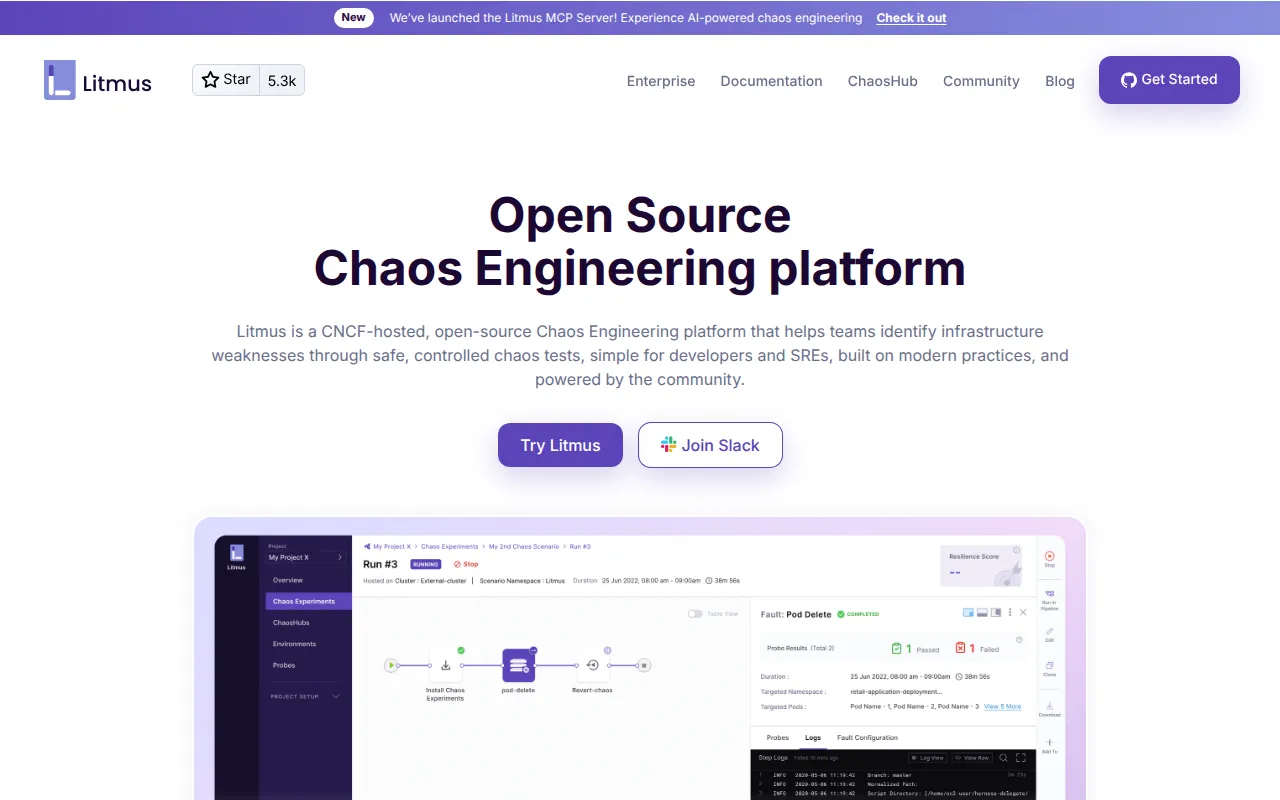
LitmusChaos is a CNCF-hosted, open-source platform designed for chaos engineering in cloud-native environments. It allows teams to intentionally introduce controlled failures into their systems to identify weaknesses and potential outages.
The tool is built for Site Reliability Engineers (SREs) and developers who manage Kubernetes clusters. It supports the creation of chaos experiments that may be scheduled or run as part of a GitOps workflow, which helps teams validate steady-state hypotheses using built-in probes.
Buyers should note that while the core platform is open source, scaled deployment and professional support are available through partners such as Harness. Additionally, users should confirm their level of Kubernetes expertise, as the core components are native to that environment.
Key Features
ChaosHub
A library of pre-built, tunable, and declarative chaos experiments.
Litmus Probes
Designed to create and verify steady-state hypotheses to assess system robustness during experiments.
MCP Server
Exposes chaos capabilities via Model Context Protocol, which supports triggering and monitoring experiments through compatible AI clients like Claude Desktop.
Chaos Studio
A user interface for adjusting chaos parameters and configurations.
Prometheus Metrics Export
Exports metrics to help quantify the impact of chaos on applications or infrastructure in real time.
Environments
Helps users organize and categorize chaos infrastructures for better collaboration.
Use Cases
Infrastructure Weakness Identification
Inducing controlled faults to find potential failure points in cloud-native applications.
Steady-State Verification
Using Litmus probes to confirm if a system returns to a healthy state after a failure is induced.
CI/CD Pipeline Reliability Testing
Integrating chaos experiments into DevOps pipelines to test resiliency before a new release.
GameDay Exercises
Running repeatable IT disaster recovery exercises to train team members on incident management.
AI-Driven Chaos Orchestration
Using natural language via an MCP client to discover and run chaos experiments.
Integrations
- Prometheus
- Grafana
- Backstage
- GitHub
- Argo CD
- Flux
FAQ
Can LitmusChaos be used in production?
- Yes, it is designed for production use, though it is recommended that new users first test it in a development environment.
Does it work outside of Kubernetes?
- While some ansible faults can run outside the cluster, the core components like the chaos-operator and runner are Kubernetes-native.
How is the resilience score calculated?
- The score is based on the weight given to a fault multiplied by the probe success percentage, aggregated across all faults in an experiment.
Is LitmusChaos 3.0 backward compatible with 2.0?
- No, LitmusChaos 3.0.0 is not backward compatible with version 2.0.0.
Source category: Software Development
Source subcategory: DevOps Platform
More tools in Software Development
Other published listings in the Software Development category.


More tools in the DevOps Platform software type
Related listings that share the same software type for comparison and shortlisting.