AI TOOL PROFILE
AutoLoop: On-Chain Game Automation Protocol

- Software Development
- Workflow Automation
- Game Development Studios
- Blockchain Companies
- Smart Contract Developers
Pricing
Pricing is usage-based and paid in ETH per tick: Standard mode is $0.0080, Hybrid VRF is $0.0094, and Full VRF is $0.022.
At a glance
- Best for
- Game Development Studios, Blockchain Companies, Smart Contract Developers
- Key use cases
- On-Chain Game Loop Automation, Randomized Game Events, Automated Contract Triggers
- Integrations
- TypeScript SDK, MCP Server
- Official website
- Visit autoloop official website
How AI is used
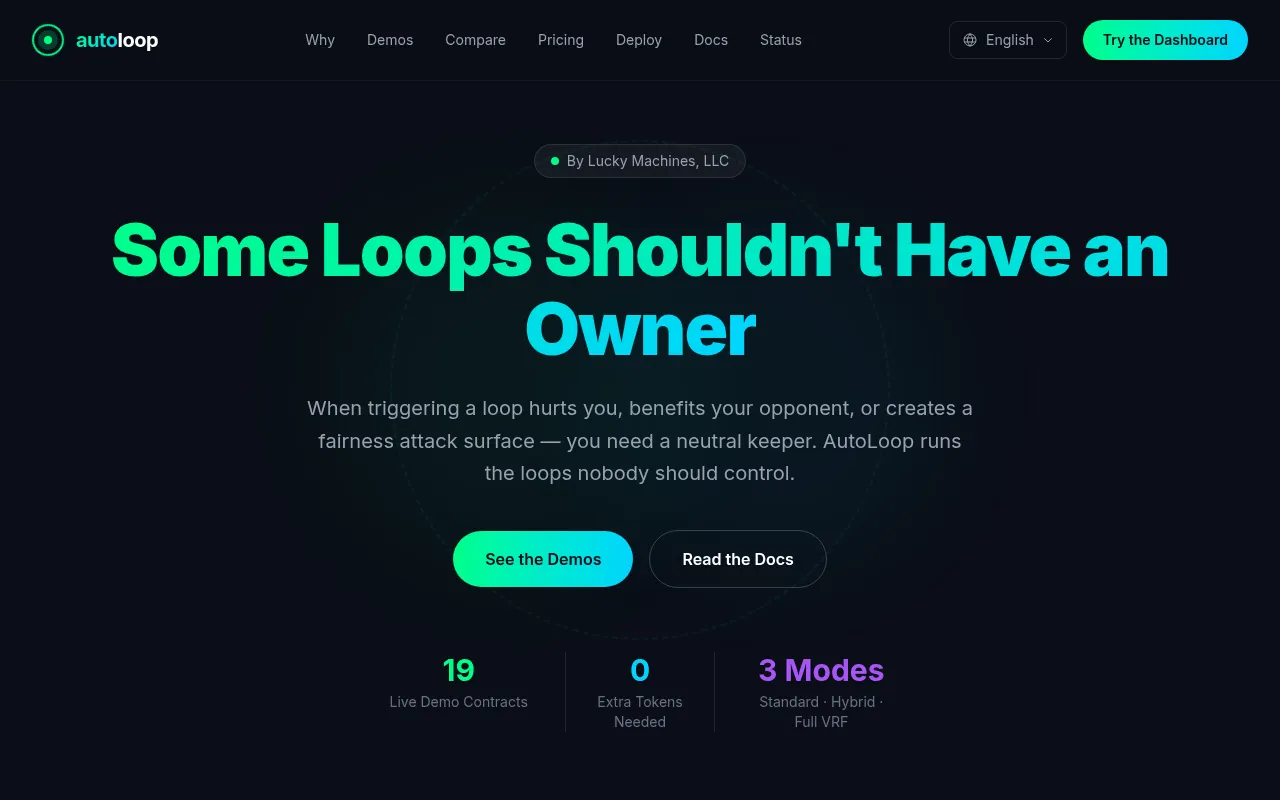
AutoLoop is a decentralized protocol designed to automate smart contract loops for blockchain-based gaming. It uses off-chain workers that detect and execute triggers, which helps game logic progress without requiring manual intervention or centralized servers.
The tool is built for developers at game studios and blockchain firms managing repeatable on-chain actions. It supports three modes of operation—Standard, Hybrid VRF, and Full VRF—allowing users to choose between basic automation or the inclusion of verifiable randomness for game events.
Technical implementation is supported via a TypeScript SDK and AI-native MCP tools. Payments are made in native ETH per execution tick.
Buyers should note that the protocol is currently unaudited. While live on Ethereum mainnet and Sepolia, support for other networks such as Base and Polygon is planned.
Key Features
Three Automation Modes
Supports Standard (pure automation), Hybrid VRF (selective randomness), and Full VRF (randomness on every tick) to fit different game logic requirements.
Built-in Verifiable Randomness
Uses native ECVRF proof generation and on-chain verification to provide outcomes without external oracles.
Decentralized Worker Network
Uses a permissionless fleet of off-chain workers that monitor contracts and execute loops when readiness conditions are met.
Role-Based Access Control
Designed to ensure that only registered controllers can trigger automation loops.
Native ETH Payments
Fees are charged in ETH per execution tick, removing the need for separate utility tokens.
Use Cases
On-Chain Game Loop Automation
Executing repeating game logic, such as incrementing counters or updating game states at regular intervals.
Randomized Game Events
Supporting outcomes for loot drops, critical hits, and spawns using VRF modes.
Automated Contract Triggers
Using off-chain workers to detect when a contract is ready for an update and triggering the loop.
Integrations
- TypeScript SDK
- MCP Server
FAQ
How does AutoLoop pricing work?
- AutoLoop uses a fee-on-execution model paid in ETH. Costs vary by mode: Standard is $0.0080 per tick, Hybrid VRF is $0.0094, and Full VRF is $0.022.
Which networks are supported by AutoLoop?
- It is currently live on Ethereum mainnet and Sepolia testnet, with support for Base, Arbitrum, and Polygon planned.
Is AutoLoop audited?
- No, AutoLoop is currently unaudited. The developers suggest using the Sepolia testnet before deploying to mainnet.
What is the difference between Standard and Hybrid VRF modes?
- Standard mode provides pure automation without randomness. Hybrid VRF allows a contract to use standard ticks for most operations and only trigger VRF randomness when requested.
Source category: Software Development
Source subcategory: Workflow Automation
More tools in Software Development
Other published listings in the Software Development category.


More tools in the Workflow Automation software type
Related listings that share the same software type for comparison and shortlisting.


