AI TOOL PROFILE
Sonar Review: Code Analysis and Quality Software

- Software Development
- Code Analysis
- Software companies
- Enterprise development teams
- DevOps engineers
- Organizations using AI coding assistants
Pricing
A free tier is available for private projects up to 50k lines of code. The Team plan starts at $32/month, while the Enterprise plan requires contacting sales for annual pricing.
At a glance
- Best for
- Software companies, Enterprise development teams, DevOps engineers, Organizations using AI coding assistants
- Key use cases
- Verifying AI-Generated Code, Automated Code Review, Compliance Reporting, Supply Chain Security
- Integrations
- GitHub, GitLab, Azure DevOps, Bitbucket, Jira
- Official website
- Visit sonar official website
How AI is used
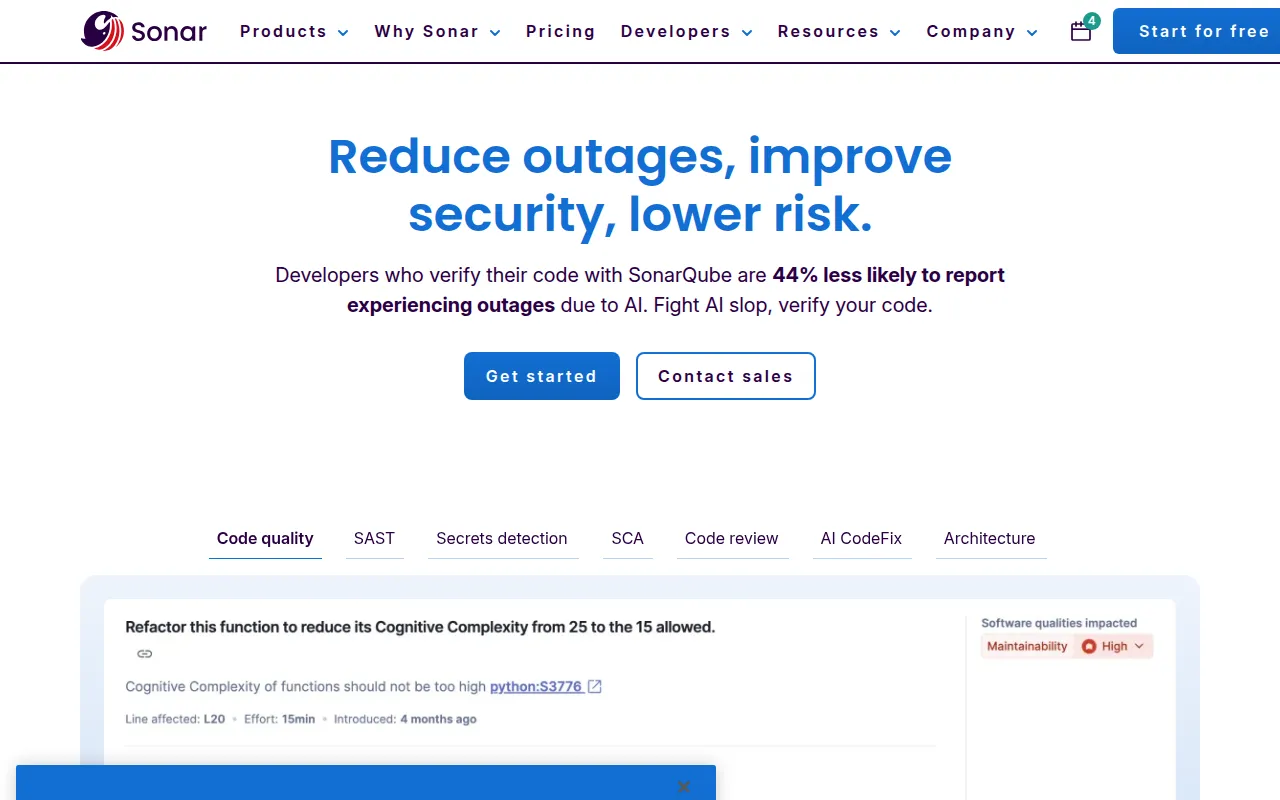
Sonar is a code quality and security platform designed to help developers find and fix bugs, vulnerabilities, and code smells. It supports teams that need to ensure both human-written and AI-generated code meet organizational standards before reaching production.
The platform offers different deployment options, including a managed SaaS version (SonarQube Cloud) and a self-managed version (SonarQube Server), as well as a free IDE extension for feedback during the coding process.
It supports a "shift-left" approach, which is designed to identify security risks and quality issues early in the development lifecycle. This may help teams reduce the risk of outages and security incidents by integrating checks into CI/CD pipelines.
Buyers should confirm whether their specific programming languages are supported and evaluate if the line-of-code limits on the free and team plans align with their project sizes.
Key Features
Static Application Security Testing (SAST)
Automatically detects security vulnerabilities and misconfigurations in the source code.
Software Composition Analysis (SCA)
Identifies risks in open-source dependencies and generates a Software Bill of Materials (SBOM).
Secrets Detection
Scans for hard-coded API keys, passwords, and security tokens to prevent accidental exposure.
AI CodeFix
Uses large language models to suggest context-aware fixes for detected bugs and vulnerabilities.
Infrastructure-as-Code (IaC) Scanning
Identifies misconfigurations in Terraform, Kubernetes, and Ansible files.
Quality Gates
Customizable thresholds that act as go/no-go checkpoints for merging or releasing code.
Use Cases
Verifying AI-Generated Code
Validating code produced by AI agents or LLMs for security and quality to prevent issues from entering production.
Automated Code Review
Integrating automated scanning into CI/CD pipelines to support consistent standards across pull requests.
Compliance Reporting
Generating reports to support adherence to security standards such as OWASP Top 10, PCI DSS, and CWE.
Supply Chain Security
Managing third-party dependency risks and tracking open-source library vulnerabilities.
Integrations
- GitHub
- GitLab
- Azure DevOps
- Bitbucket
- Jira
- Jenkins
- Slack
FAQ
What is the difference between SonarQube Cloud and Server?
- SonarQube Cloud is a managed SaaS solution, while SonarQube Server is a self-managed platform for organizations needing control over their environment.
Is there a free version of Sonar?
- Yes, there is a free tier for SonarQube Cloud limited to 50k lines of code for private projects, and a free extension called SonarQube for IDE.
How does Sonar handle AI-generated code?
- Sonar uses static analysis and features like AI CodeFix to identify bugs and vulnerabilities in AI-written code and suggest automated remediation.
Which programming languages are supported?
- Sonar supports over 40 languages, including Java, JavaScript, Python, C#, and C++, as well as various IaC technologies.
Source category: Software Development
Source subcategory: Code Analysis
More tools in Software Development
Other published listings in the Software Development category.


More tools in the Code Analysis software type
Related listings that share the same software type for comparison and shortlisting.