AI TOOL PROFILE
HumanLayer: AI Coding Agent Orchestration

- Software Development
- AI Code Assistant
- Software companies
- Enterprise development teams
- Advanced Claude Code users
- Technical founders
Pricing
Pricing was not clearly available from the provided evidence. Buyers should confirm current pricing on the vendor website.
At a glance
- Best for
- Software companies, Enterprise development teams, Advanced Claude Code users, Technical founders
- Key use cases
- Managing Complex Codebases, Parallel Development Workflows, Scaling AI Dev Across Teams, Custom AI Workflow Integration
- Official website
- Visit HumanLayer official website
How AI is used
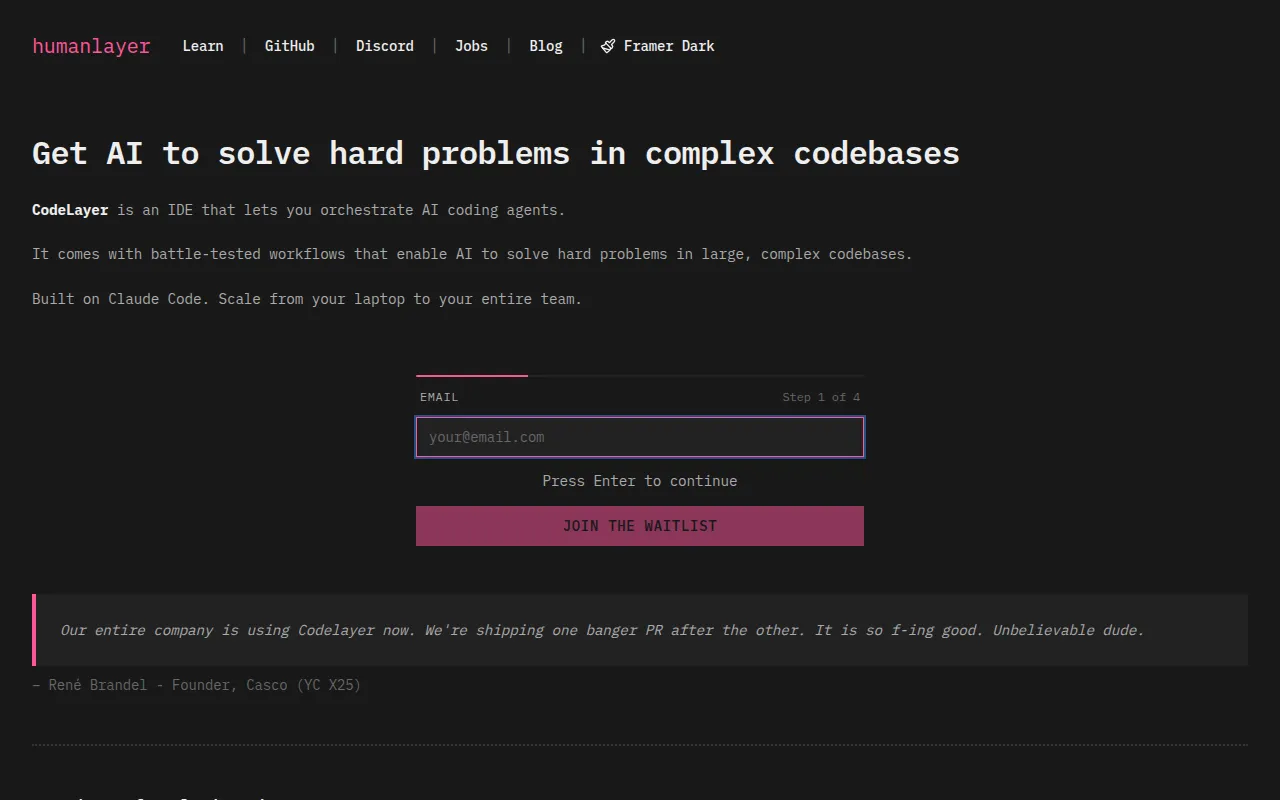
HumanLayer offers a specialized IDE, CodeLayer, designed to orchestrate AI coding agents. Built on Claude Code, the tool is intended to help developers address problems within large, complex codebases by providing structured workflows.
The software is designed for development teams and software companies moving toward an AI-first engineering approach. It features keyboard-first interactions for developers who prefer high-control navigation.
Capabilities include running parallel coding sessions and managing agent workloads via remote cloud workers. For larger organizations, the company offers enterprise services that include custom integrations and tailored workflows.
Buyers should confirm the technical requirements, as the tool is designed for those familiar with AI agent orchestration and Claude Code.
Key Features
AI Coding Agents
Deploy and orchestrate fleets of agents to handle coding tasks within complex repositories.
Parallel Claude Sessions
Supports running multiple Claude Code sessions simultaneously to manage different tasks.
Keyboard-First Workflows
Interface designed for speed and control, catering to developers who prefer keyboard navigation.
Worktrees Support
Supports git worktrees to help organize parallel agent workloads.
Remote Cloud Workers
Allows teams to scale AI agent execution via the cloud.
Enterprise Engineering Support
Offers tailored workflows and custom integrations provided by the HumanLayer engineering team.
Use Cases
Managing Complex Codebases
Using AI agents to research, plan, and implement changes in large-scale software projects.
Parallel Development Workflows
Running multiple AI coding sessions in parallel to support the delivery of multiple pull requests.
Scaling AI Dev Across Teams
Using remote cloud workers to synchronize agent workloads across an engineering organization.
Custom AI Workflow Integration
Collaborating with HumanLayer engineers to build specific AI-first development processes for an enterprise.
FAQ
What is HumanLayer's CodeLayer?
- CodeLayer is an IDE that allows developers to orchestrate AI coding agents, built on Claude Code to help solve problems in large, complex codebases.
Who is HumanLayer designed for?
- It is designed for software companies and enterprise development teams that want to scale AI-first development across their organization.
What are parallel Claude sessions?
- This feature allows users to run multiple Claude Code sessions at once, which may help in managing different tasks or worktrees simultaneously.
Does HumanLayer offer enterprise support?
- Yes, they provide enterprise services including tailored workflows, custom integrations, and direct engineering support.
Source category: Software Development
Source subcategory: AI Code Assistant
More tools in Software Development
Other published listings in the Software Development category.


More tools in the AI Code Assistant software type
Related listings that share the same software type for comparison and shortlisting.


